
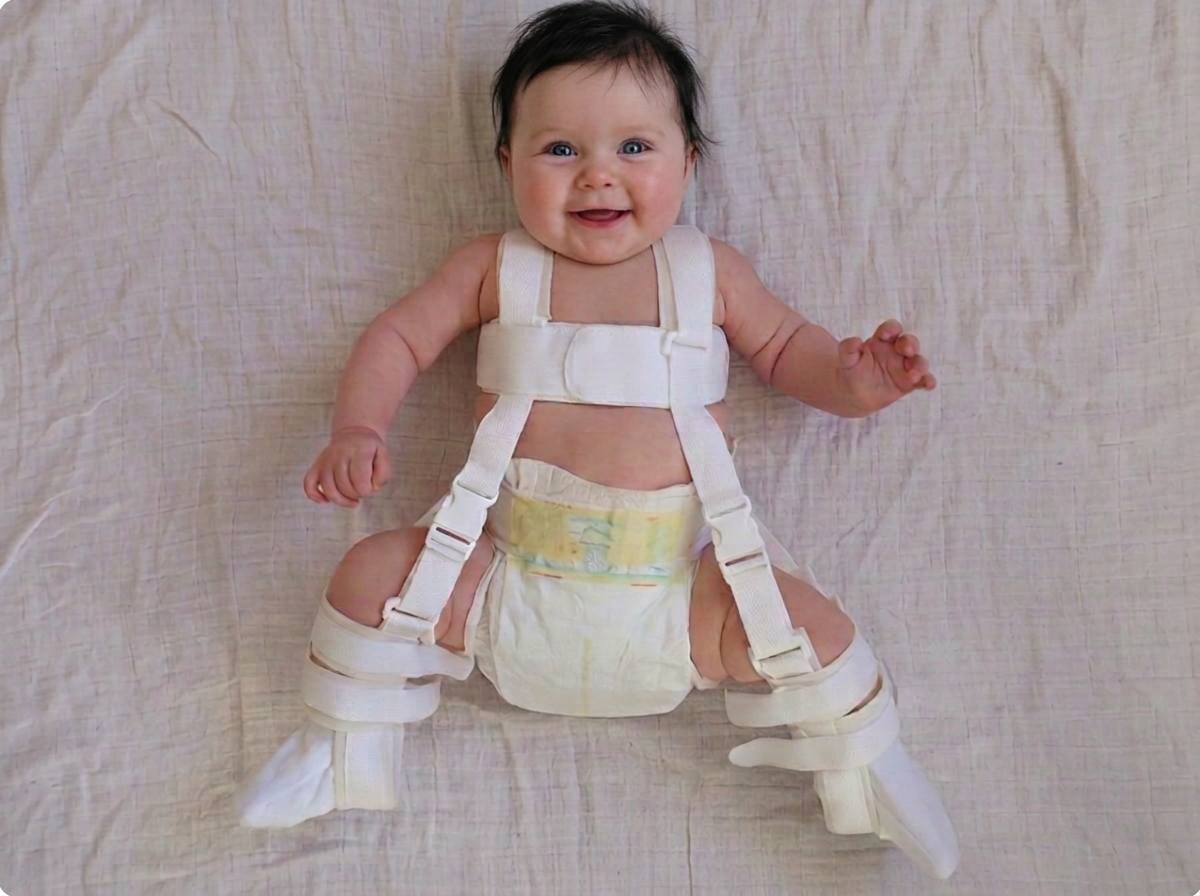
A Pavlik harness only works if the chest strap sits firmly at the right level and the stirrups reach the feet without stretching the straps to their limit. Size is determined primarily by chest circumference, with weight and age as cross-checks.
How to measure
- Lay your baby on their back, calm and not immediately after a feed.
- Run a soft tape around the chest at the level just below the nipples.
- Keep the tape snug but not compressing — you should slide one finger under it.
- Read the measurement at the end of a normal breath out. Record in centimetres.
Our size chart
- Small — 0 to 3 months, 3.0 to 5.5 kg, chest 33 to 38 cm.
- Medium — 3 to 6 months, 5.5 to 8.0 kg, chest 38 to 44 cm.
- Large — 6 to 9 months, 8.0 to 10.5 kg, chest 44 to 50 cm.
If your baby is between sizes
Choose the larger size when the chest measurement is within 1 cm of the upper limit of a band, or when your baby is gaining weight quickly. Every strap on the harness is adjustable downward, so a slightly larger harness can be brought in — an undersized one cannot be let out.
For premature or low-birth-weight infants, ask your clinic before ordering; some very small babies need a specialised neonatal harness rather than a standard Small.
Signs the harness has been outgrown
- The chest strap sits high, near the armpits, even after loosening.
- The stirrups are at their longest setting and the feet still pull against them.
- Red marks persist for more than 20 minutes after adjustment.
- The knees no longer reach the prescribed flexion angle at maximum strap length.
Ordering a spare
Many families keep a second harness so one can be washed and dried while the other is worn — useful during reflux, nappy leaks or hot weather. Any swap should keep the strap settings identical; mark the prescribed positions on the new harness with a fabric pen before the first change.