
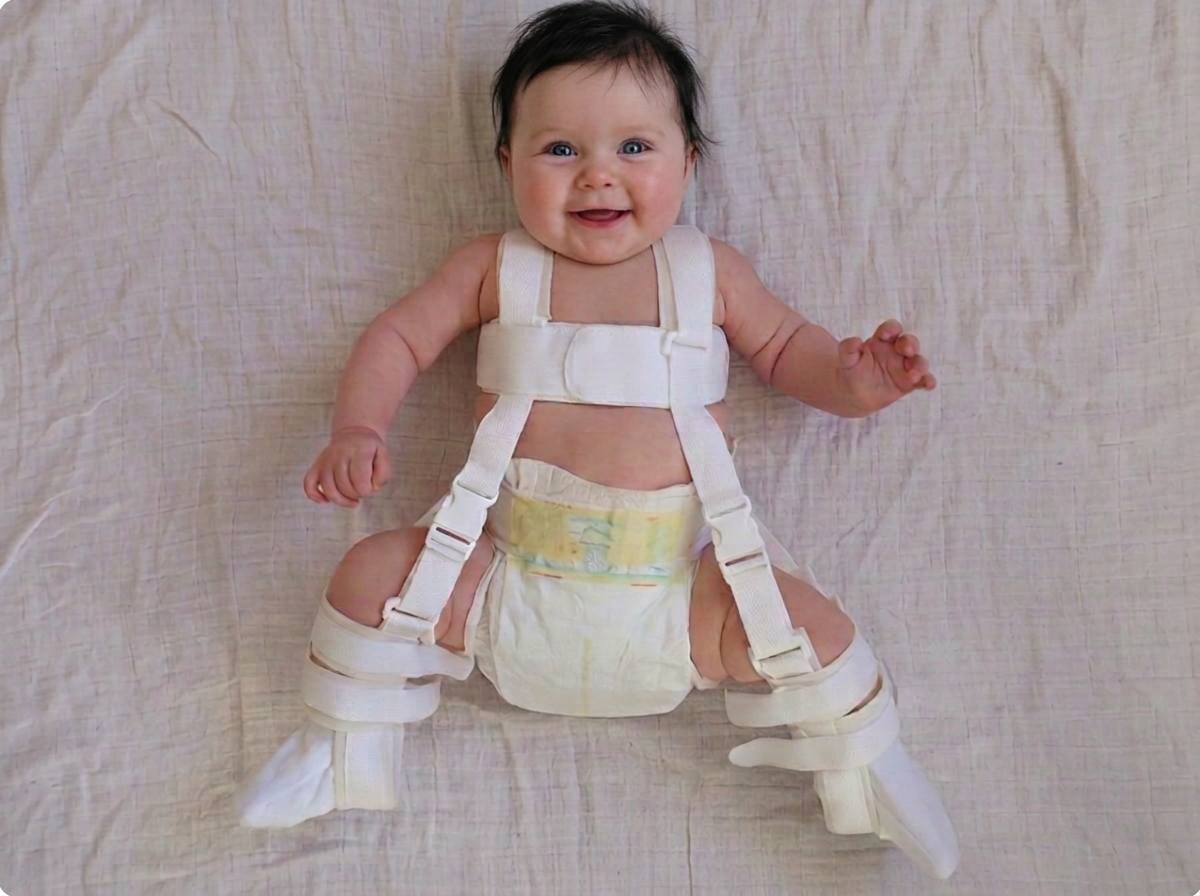
There is no single universal protocol — schedules vary between surgeons and between countries — but almost all follow the same shape: a full-time phase, a confirmation scan, then a gradual weaning phase. Your clinic's instructions always override the general pattern below.
Phase 1 — full-time wear (weeks 0 to 6)
The harness is worn 23 to 24 hours a day. Many surgeons allow no removal at all in the first one to two weeks so the hip can settle into the socket undisturbed; others permit a brief daily removal for a sponge bath once reduction is confirmed on ultrasound.
Expect a review appointment at one week and then every one to two weeks. The straps are let out as your baby grows.
Phase 2 — continued full-time wear (weeks 6 to 12)
If ultrasound at six weeks shows the hip reduced and the socket improving, full-time wear usually continues until the alpha angle reaches a normal range, typically around 60 degrees. Some stable, mild cases are weaned earlier.
Phase 3 — weaning
- Week 1 of weaning: out of the harness for one to two waking hours a day.
- Week 2: out for half the day; harness for all sleep.
- Weeks 3–4: nights and naps only.
- Weeks 5–6: nights only, then stop, with an X-ray to confirm before discharge from full-time bracing.
Why consistency beats total duration
A hip held reduced for 23 hours a day for eight weeks does better than one held for 18 hours a day for twelve weeks. Each time the harness comes off, the femoral head can drift and the socket loses the pressure that shapes it. Treat the prescribed hours as the number that matters most.
What derails a schedule
- Skin irritation that prompts unplanned removals — treat it early rather than skipping wear.
- Hot weather; use thin cotton layers rather than reducing hours.
- Travel and holidays; take a printed strap-setting diagram with you.
- Family members who are not confident applying the harness — teach everyone who cares for the baby at the fitting appointment.