
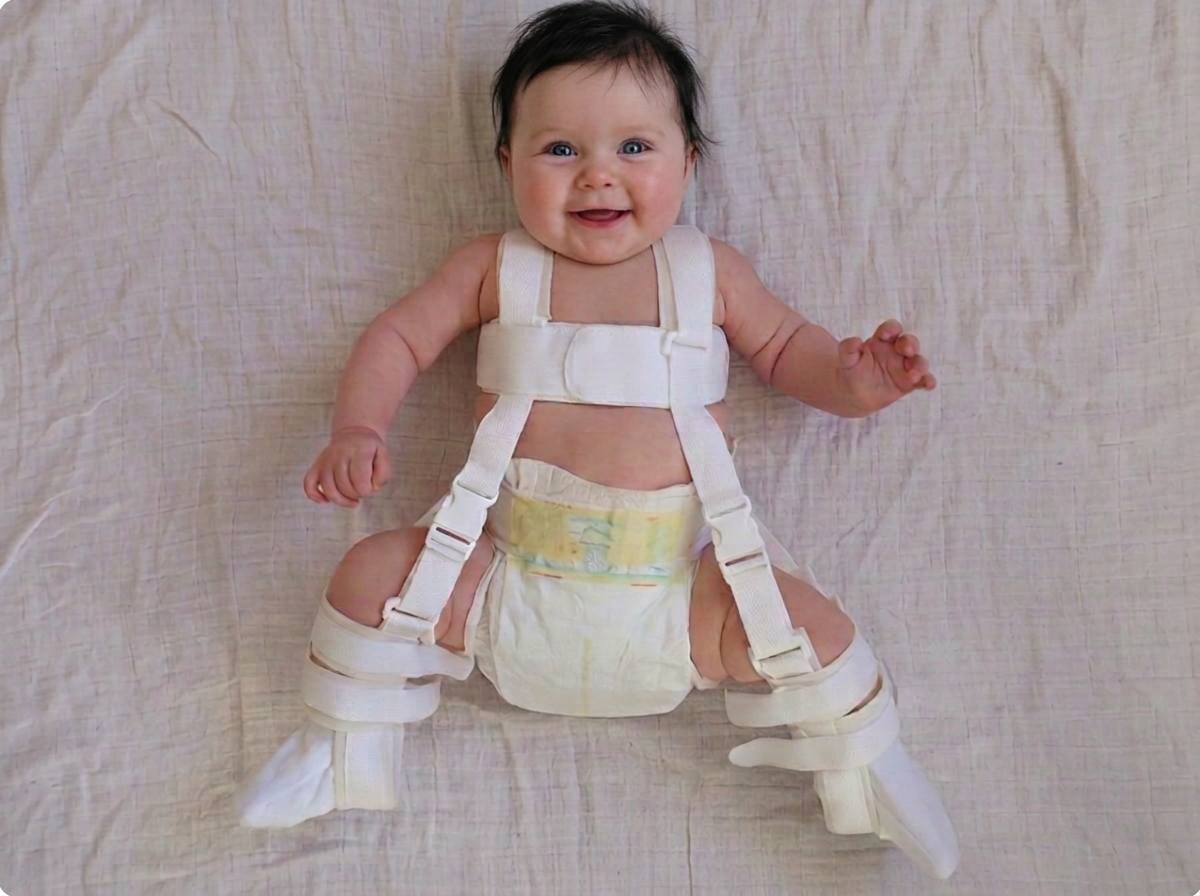
Your clinician sets the strap positions once. Your job as a parent is to reapply the harness in exactly those positions whenever it comes off. This guide covers the order that makes that reliable.
Before you start: never change the buckle positions yourself unless you have been specifically told to. Mark each prescribed setting with a permanent fabric pen at your fitting appointment.
The correct order
- Lay the baby on their back on a flat, firm surface with the harness opened flat underneath.
- Fasten the chest strap first. It sits just below the nipple line — you should slide two fingers underneath it.
- Fasten the shoulder straps so the chest strap cannot ride up toward the armpits.
- Place the left foot in the left stirrup, then the right — the ankle strap sits above the heel, not over it.
- Attach the anterior (front) straps last. These set hip flexion: knees up toward the chest, at least 90 degrees, usually closer to 100.
- Attach the posterior (back) straps, which limit how far the knees can spread. They should never pull the knees toward the mattress.
How tight is right
Two fingers should slide flat under the chest strap. One finger should slide under each ankle strap. Legs should be able to kick freely inside their permitted arc — if the baby cannot move at all, the harness is too tight.
The natural resting position is frog-like: knees up and comfortably apart, feet turned slightly outward. If the legs look forced or the feet are pressed hard against the stirrups, stop and call your clinic.
Common mistakes
- Chest strap too high — it slides toward the armpits and the whole harness loses its anchor.
- Straps loosened at night 'to help sleeping' — this is the most common cause of treatment failure.
- Legs pushed too far apart in the belief that more abduction is better. It is not; it risks avascular necrosis.
- Applying the stirrups before the chest strap, which throws off every other setting.
- Putting a thick vest under the harness after the fit was set over a thin one.
Taking it off
Only remove the harness if your clinician has explicitly allowed it — many protocols require it to stay on 24 hours a day at first. When removal is allowed for bathing, do it one leg at a time where possible, keeping the hips flexed and spread throughout, and never let the legs be straightened and brought together.