
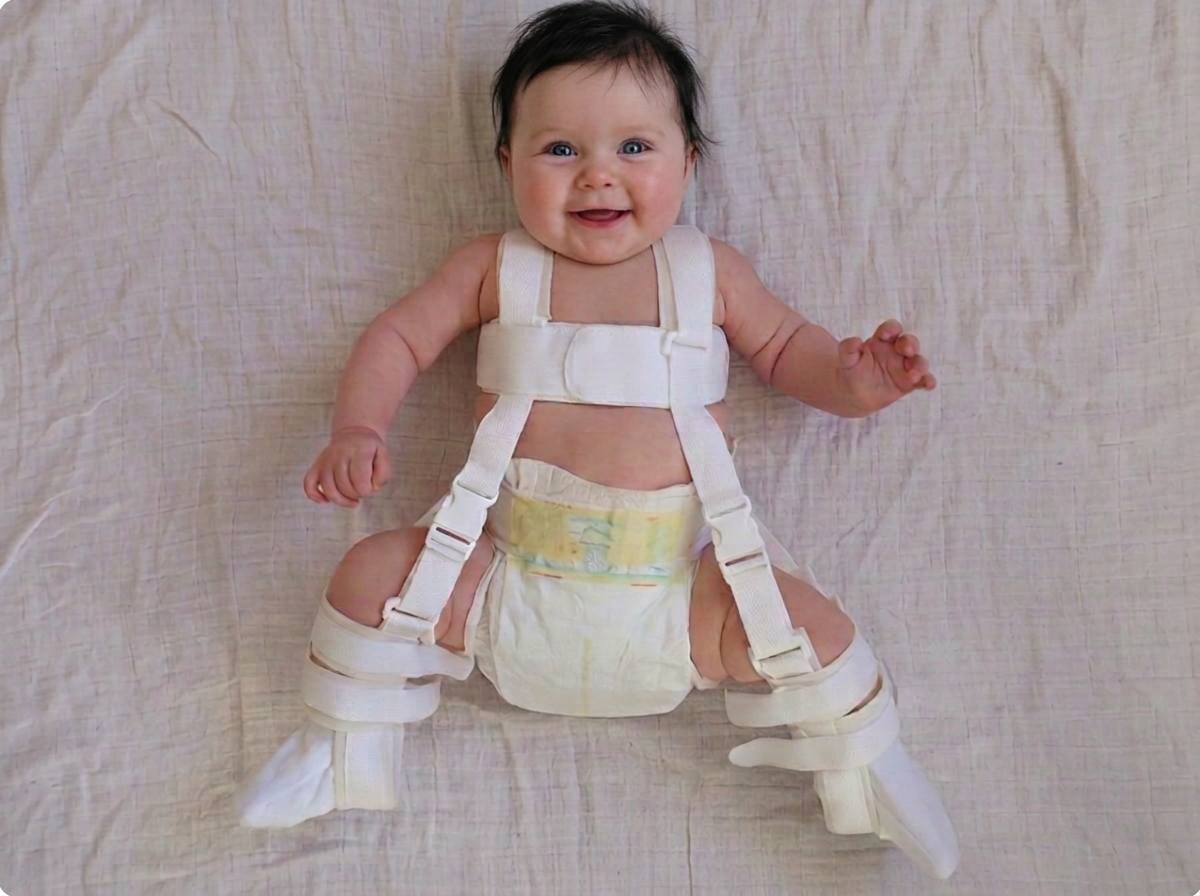
Feeding is the part of harness life that worries new parents most, and the part that resolves fastest. Babies feed perfectly well in a Pavlik harness — the holds just change, because the legs cannot straighten and the abdomen sits slightly compressed.
Breastfeeding does not need to stop, and it does not need expressing as a workaround.
Breastfeeding holds that work
- Rugby-ball (football) hold — baby tucked along your side, legs behind you. Usually the easiest with stirrups.
- Side-lying — both of you on your sides, the baby's spread legs supported by the mattress.
- Laid-back / biological nurturing — you reclined, the baby prone on your chest with legs straddling. The harness position suits this naturally.
- Modified cradle with a firm pillow under the baby's hips to take the weight of the stirrups.
Bottle feeding
Hold the baby more upright than usual — roughly 45 degrees or higher. This reduces reflux and helps with the wind that harness babies swallow more of. Support the hips and stirrups on a firm cushion so the weight is not hanging from the straps.
Paced feeding, with regular pauses, works better than a continuous feed for babies whose abdomen is slightly restricted.
Reflux and wind
Hip flexion pushes the thighs against the abdomen, which increases pressure and makes posseting more common. Feed smaller volumes more often, wind every few minutes rather than at the end, and keep the baby upright against your shoulder for ten to fifteen minutes after each feed.
If vomiting is forceful, weight gain stalls, or the baby arches and screams at every feed, tell your clinic — occasionally the chest strap sits too low and needs adjusting.
Protecting your skin and the harness
- Keep a muslin between the chest strap and any leaking milk — wet webbing is a skin risk.
- Pat the strap dry rather than removing the harness after a spill.
- Check under the chest strap after every couple of feeds in the early weeks.
- If milk soaks the harness repeatedly, ask your clinic about a spare so one can be washed.
Weight gain
Harness babies gain weight normally. If growth slows, the cause is usually feed volume rather than the device, but it is always worth a check — a harness that has become tight with growth can restrict comfortable feeding.
Frequently asked questions
Can I breastfeed with a Pavlik harness on?
Yes. The harness stays on for feeds. The rugby-ball, side-lying and laid-back positions all work well around the stirrups.
Why is my baby spitting up more since the harness?
Hip flexion raises abdominal pressure. Smaller, more frequent feeds, upright positioning and frequent winding usually settle it.
Can I take the harness off for one feed?
No — not unless your surgeon has moved you to a part-time schedule. Every removed hour reduces the chance of success.