
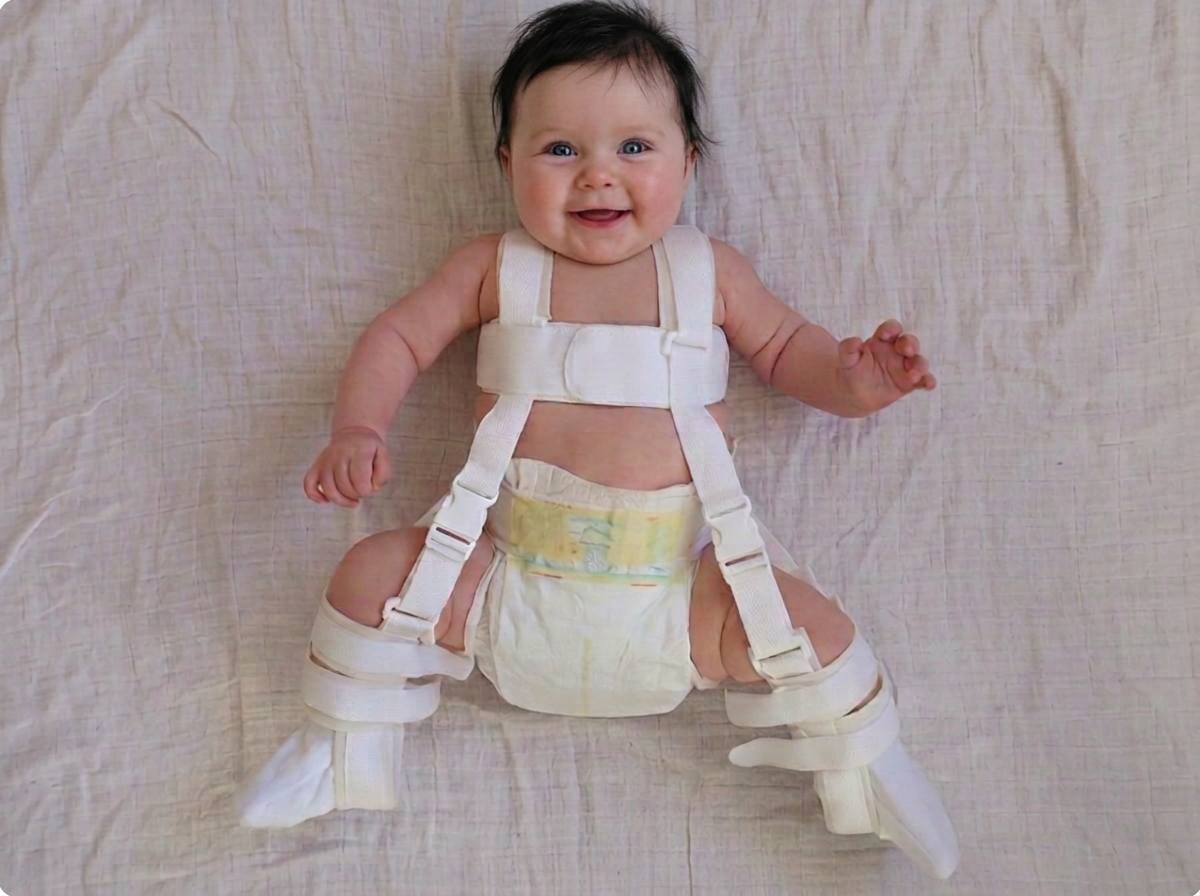
A Pavlik harness is a soft, adjustable fabric brace worn by babies with developmental dysplasia of the hip (DDH). It is not a cast and it is not rigid: it is a set of straps that gently holds the legs in a bent-and-spread position so the ball of the thigh bone sits deep inside the hip socket while the joint finishes growing.
It was designed in the 1940s by the Czech orthopaedic surgeon Arnold Pavlik, and eighty years later it is still the first-line treatment for hip dysplasia in babies under about six months of age worldwide. Most parents meet it within days or weeks of a newborn hip screening result.
What the harness actually does
A newborn hip socket is made largely of cartilage. It only deepens properly when the rounded head of the femur is held inside it and applies steady, gentle pressure. In hip dysplasia the socket is too shallow, or the femoral head slips partly or completely out of it.
The Pavlik harness solves this mechanically. By holding the hips flexed to roughly 100–110 degrees and abducted (spread apart) to about 50–70 degrees, it centres the femoral head in the socket. The baby can still kick within that safe arc, and that active kicking is part of the treatment — the movement moulds the socket deeper week by week.
The parts of a Pavlik harness
- Chest strap: fastens around the chest just below the nipple line and anchors everything else.
- Shoulder straps: cross over the back and hold the chest strap in position.
- Anterior (front) straps: control hip flexion — how high the knees are lifted.
- Posterior (back) straps: control abduction — how far the knees can spread apart.
- Foot stirrups: soft booties that hold the lower leg and connect it to the straps.
Who is a Pavlik harness for?
It is used for babies diagnosed with DDH — a dislocatable hip, a subluxated hip, a frankly dislocated but reducible hip, or a shallow (dysplastic) socket found on ultrasound. It works best between birth and about six months.
It is generally not suitable for babies over six months, for hips that cannot be reduced into the socket, for babies with significant muscle imbalance or ligament laxity syndromes, or when there is a knee or hip contracture. In those situations a surgeon usually moves to closed reduction and a spica cast.
How long will my baby wear it?
Most protocols start with full-time wear — 23 to 24 hours a day — for the first six to twelve weeks, followed by a weaning period where wear reduces to nights and naps only. Total treatment usually runs between six and twelve weeks of full-time wear plus a few weeks of weaning, but your surgeon sets the schedule based on repeat ultrasound findings.
Does it hurt?
No. A correctly fitted harness is not painful. Babies typically fuss for the first 24 to 72 hours because the position is unfamiliar, then settle completely. Persistent crying, refusal to feed, or a leg that stops kicking are not normal — those are reasons to contact your clinic the same day.
How well does it work?
Published success rates for stable, reducible hips treated early sit between 85 and 95 percent. Success is highest when treatment begins in the first weeks of life and when the harness is worn exactly as prescribed. The single biggest predictor of failure is inconsistent wear.
Frequently asked questions
Is a Pavlik harness the same as a hip brace?
A Pavlik harness is one type of hip abduction brace. Others — such as the Rhino or Denis Browne bar — are usually semi-rigid and used later, after harness treatment or for milder dysplasia in older infants.
Can I buy a Pavlik harness myself?
You can buy the harness, but it must be fitted and its straps set by a qualified clinician, and hip position must be confirmed by ultrasound. Never set the straps yourself from a photograph.