
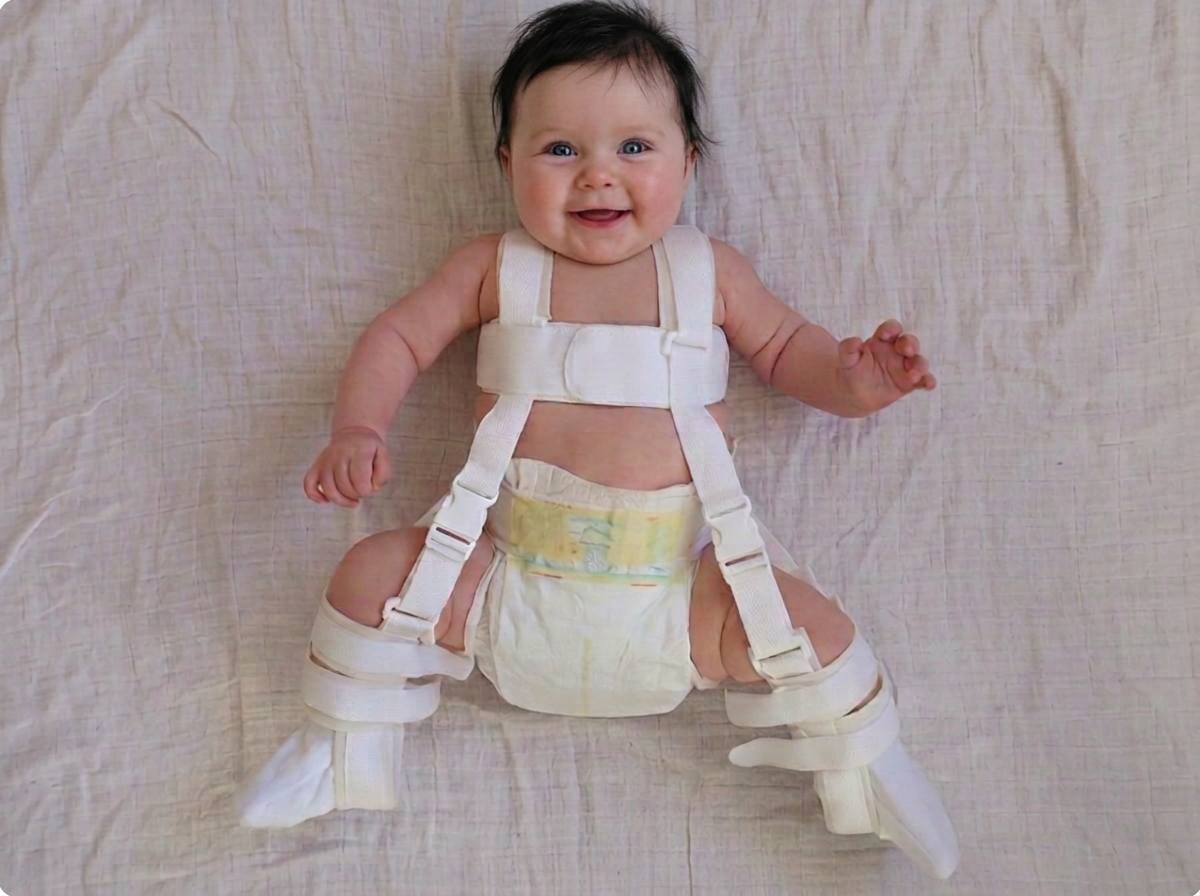
Developmental dysplasia of the hip (DDH) means the ball-and-socket joint of a baby's hip has not formed in the right shape or the right position. The socket may be too shallow, the ball may sit loosely inside it, or the ball may be partly or fully out of the socket. It affects roughly 1 to 3 in every 1,000 babies severely enough to need treatment, and mild instability is found in many more at newborn screening.
This is the hub page for everything on this site. It explains DDH from screening to discharge, and links to the detailed guide for each stage. If your baby was diagnosed today, read this page first, then follow the links that match where you are.
What DDH actually is
A newborn hip socket (the acetabulum) is mostly cartilage. It only deepens into a proper cup when the rounded head of the thigh bone is held inside it and applies steady pressure while the baby kicks. If the head is not centred — because the joint is loose, or because the baby was positioned tightly in the womb — the socket stays shallow and the joint can slip.
The condition is called developmental rather than congenital because it can appear, worsen, or resolve during the first months of life. That is also why it is screened for repeatedly rather than once.
Who is more likely to have it
- Breech position in the third trimester — the single strongest risk factor.
- A first-degree relative (parent or sibling) treated for hip dysplasia.
- Female babies — around four in five treated cases are girls.
- First-born babies, where the uterus is tighter.
- Oligohydramnios (low amniotic fluid) or twin pregnancy.
- Swaddling with the legs held straight and pressed together after birth.
How DDH is diagnosed
At the newborn examination a clinician performs the Ortolani and Barlow manoeuvres, gently testing whether the hip can be pushed out of or slipped back into the socket. Asymmetric thigh creases, a clunk, or limited spreading of one leg all trigger further imaging.
Under six months of age the imaging test is ultrasound, which shows the cartilage directly and gives an alpha angle measuring socket depth. After about six months the femoral head has begun to ossify and X-ray becomes the better test. Imaging — not the harness, and not a photograph — is what confirms the hip is properly reduced.
The treatment ladder
- Birth to ~6 months: Pavlik harness, worn 23-24 hours a day initially, with ultrasound checks.
- If the harness does not reduce the hip within 3-4 weeks: a semi-rigid abduction brace, or closed reduction under anaesthetic with a spica cast.
- 6-18 months: usually closed reduction and spica cast; sometimes open reduction.
- Older than 18 months or failed reduction: open surgery, occasionally with a bone-cut (osteotomy) to reshape the socket or femur.
Why early treatment matters so much
Treated in the first weeks of life with a harness, 85-95 percent of reducible hips normalise without surgery. Treated at nine months, most babies need an operation and a cast. Untreated dysplasia is a leading cause of hip arthritis in young adults, often producing a hip replacement in the thirties or forties.
The clinical urgency parents feel at diagnosis is real, but the news is good: the earlier this is caught, the simpler and gentler the fix.
What the whole journey usually looks like
A typical harness course runs like this: diagnosis and fitting in week one; a check ultrasound and strap adjustment at weeks one to two; full-time wear for six to twelve weeks with reviews every two to three weeks; then weaning to nights and naps for a further two to six weeks; then a final ultrasound or X-ray and discharge, with a follow-up X-ray around walking age and sometimes again at skeletal maturity.
Where to go next
- New to the device: read What Is a Pavlik Harness? and How a Pavlik Harness Treats Hip Dysplasia.
- Just fitted: read How to Put On and Adjust a Pavlik Harness and the Wear Schedule guide.
- Daily life: Sleeping, Bathing, Clothing and Nappies, and Skin Care.
- Worried it is not working: Signs the Pavlik Harness Is Working and When a Pavlik Harness Fails.
Frequently asked questions
Is hip dysplasia my fault?
No. DDH is driven by genetics and by how the baby was positioned in the womb. Nothing a parent did or did not do during pregnancy causes it. The one thing within your control after birth is avoiding tight straight-leg swaddling.
Will my child walk normally?
Yes, in the great majority of cases treated in infancy. Babies treated successfully with a harness typically walk at a normal age and have no lasting limp or limitation.
Can DDH come back after treatment?
Residual dysplasia can appear later in a small proportion of children, which is why surgeons often take a follow-up X-ray around walking age and sometimes again in later childhood.