
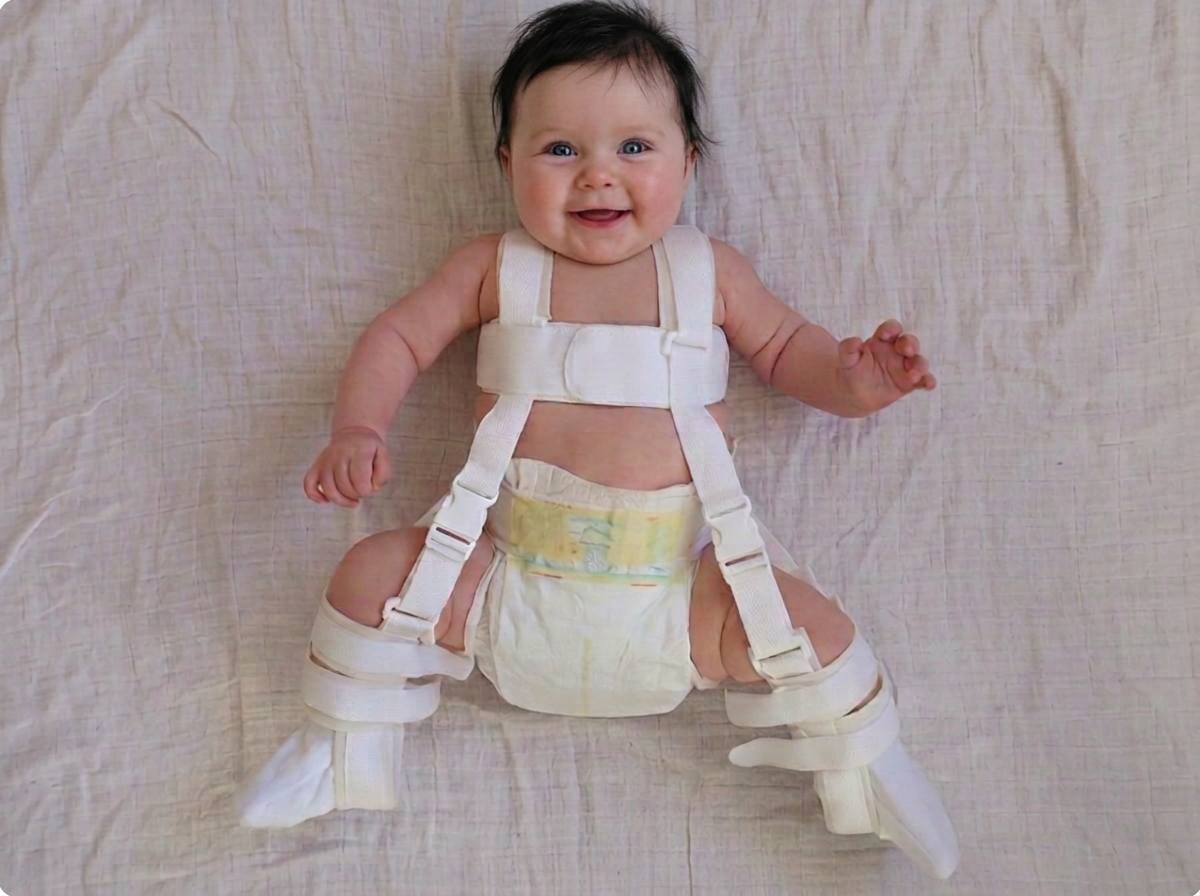
"Hip dysplasia brace" covers several very different devices. They are not interchangeable, and which one your baby needs depends almost entirely on age, on whether the hip can be pushed back into the socket, and on what the ultrasound shows.
This guide compares the four devices parents most often hear about, so you understand what your surgeon has chosen and why.
Pavlik harness — the soft, first-line option
A set of fabric straps with foot stirrups that holds the hips flexed to about 100-110 degrees and spread to 50-70 degrees, while still letting the baby kick within that safe arc. Used from birth to roughly six months for reducible hips. It is the most-prescribed device in the world for infant DDH and the one this site supplies.
Advantages: soft, washable, adjustable, allows movement (which itself moulds the socket), and can be removed for bathing once the surgeon allows. Limits: it relies on correct strap settings and consistent wear, and it is not suitable for hips that will not reduce.
Rhino / abduction brace — the semi-rigid step-up
A moulded plastic shell with a hinged abduction bar, holding the legs apart at a fixed angle. Typically used for babies over about four to six months, for milder residual dysplasia, or after harness treatment as a weaning device. It is more rigid and less adjustable than a harness but easier to apply consistently.
Von Rosen splint — the malleable metal splint
A soft-covered malleable metal H-shaped splint, popular in parts of Scandinavia and the UK for newborns. A clinician bends it to the individual baby. It is very hard to misapply once set, which is its main advantage, but it is much less common outside a handful of centres.
Spica cast — the rigid, surgical option
A fibreglass cast from chest to ankles applied under anaesthetic after a closed or open reduction. Not a brace you buy: it is applied in theatre and changed every six to eight weeks. Used when a harness has failed, when the baby is older than about six months at diagnosis, or when reduction requires anaesthesia.
Quick comparison
- Pavlik harness — 0-6 months, soft, adjustable, allows kicking, first-line for reducible hips.
- Rhino / abduction brace — 4-12 months, semi-rigid, fixed abduction, often used for weaning or milder dysplasia.
- Von Rosen splint — newborn, malleable metal, clinician-shaped, region-specific.
- Spica cast — any age post-reduction, rigid, applied under anaesthetic, no removal at home.
How your surgeon chooses
Three questions decide it: how old is the baby, does the hip reduce into the socket, and is the family able to keep the device on as prescribed. Under six months with a reducible hip, the answer is almost always a Pavlik harness. Over six months, or with a hip that will not stay in, the answer moves toward reduction and a cast.
If a device is recommended that is not what you expected, ask your surgeon to show you the ultrasound and explain the alpha angle. Good clinics welcome that question.
Frequently asked questions
Is a Pavlik harness a brace?
Yes — it is the soft, dynamic type of hip abduction brace. Unlike a rigid brace it allows the baby to kick within a controlled range, and that movement helps deepen the socket.
Can I choose which brace my baby wears?
No. The device must match the hip's age and reducibility, and its settings must be confirmed by imaging. A device chosen without imaging can push a hip out of the socket rather than into it.
Is a more rigid brace more effective?
Not for infants with reducible hips. Excessive rigidity and forced abduction increase the risk of avascular necrosis of the femoral head. The harness works precisely because it is gentle and allows movement.