
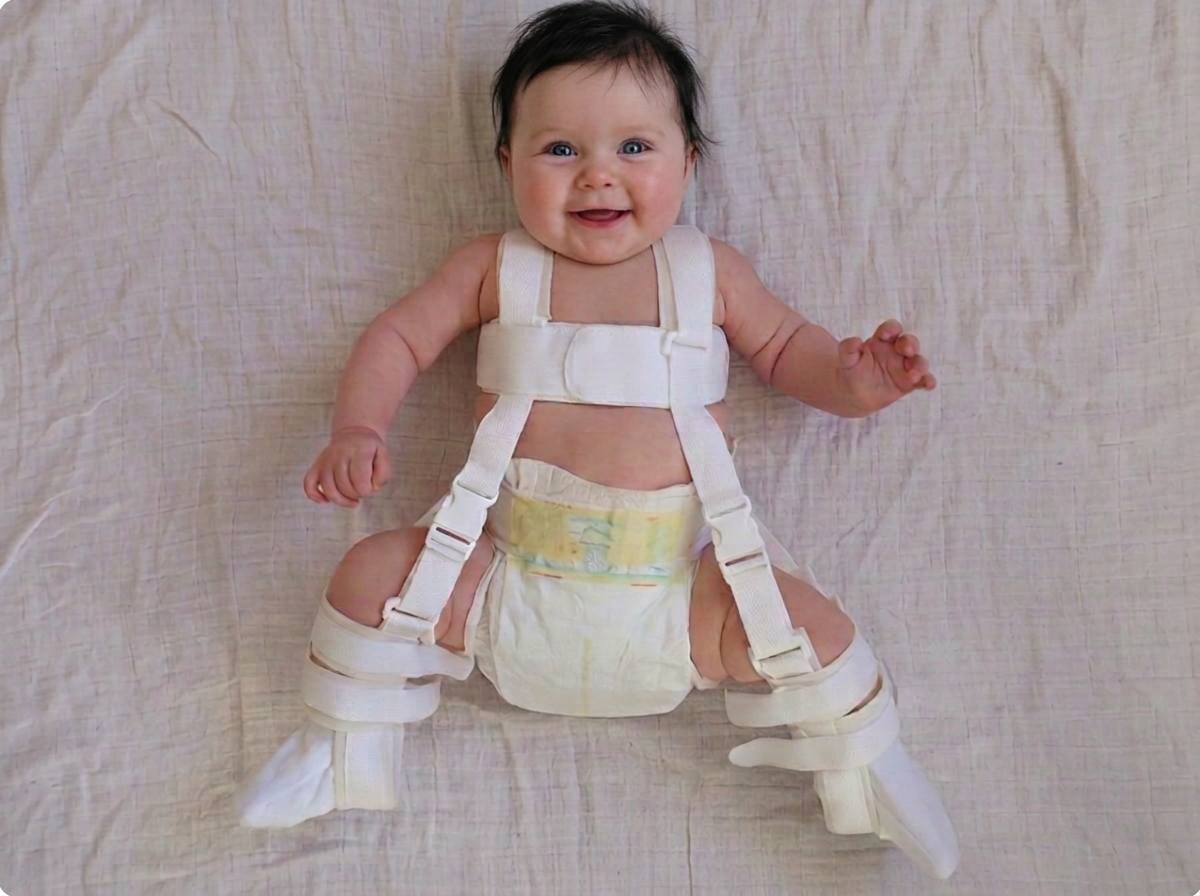
Roughly four out of five babies treated for developmental dysplasia of the hip are girls. It is one of the most consistent findings in the whole condition, and it has a straightforward biological explanation.
It also has a practical consequence: sex is a screening risk factor, and it compounds with the others.
Why girls more than boys
Female babies are more sensitive to relaxin and other maternal hormones circulating in late pregnancy, which loosen ligaments in preparation for birth. A looser hip capsule allows more movement of the femoral head, and a head that is not held centred does not shape the socket.
Girls also have slightly greater baseline ligament laxity, which persists for a few weeks after birth while maternal hormone levels fall.
How risk factors combine
- Female sex alone — several times the background risk.
- Female plus breech — the highest-risk common combination, and an automatic indication for ultrasound.
- Female plus family history — also an automatic indication for imaging.
- Female, first-born, breech, with a family history — the group most guidelines screen without exception.
What this means in practice
Sex alone does not make a scan mandatory in most systems, but it lowers the threshold. If your daughter has any second risk factor — breech, family history, low fluid, twin pregnancy, or any examination finding — ask for an ultrasound at around six weeks and make sure it is booked before you leave the clinic.
The left hip
Around 60 percent of cases affect the left hip, and both hips are affected in about 20 percent. The left-sided predominance is thought to reflect the most common fetal position, with the left hip pressed against the mother's spine.
Frequently asked questions
Why is hip dysplasia more common in girls?
Female babies respond more strongly to the maternal hormones that loosen ligaments before birth, so the hip capsule is looser and the femoral head is less well centred in the socket.
Should every baby girl have a hip ultrasound?
Most guidelines do not screen every girl, but sex lowers the threshold. With any second risk factor — breech, family history, examination findings — ultrasound is recommended.
Which hip is usually affected?
The left hip in around 60 percent of cases, with both hips affected in about 20 percent.