
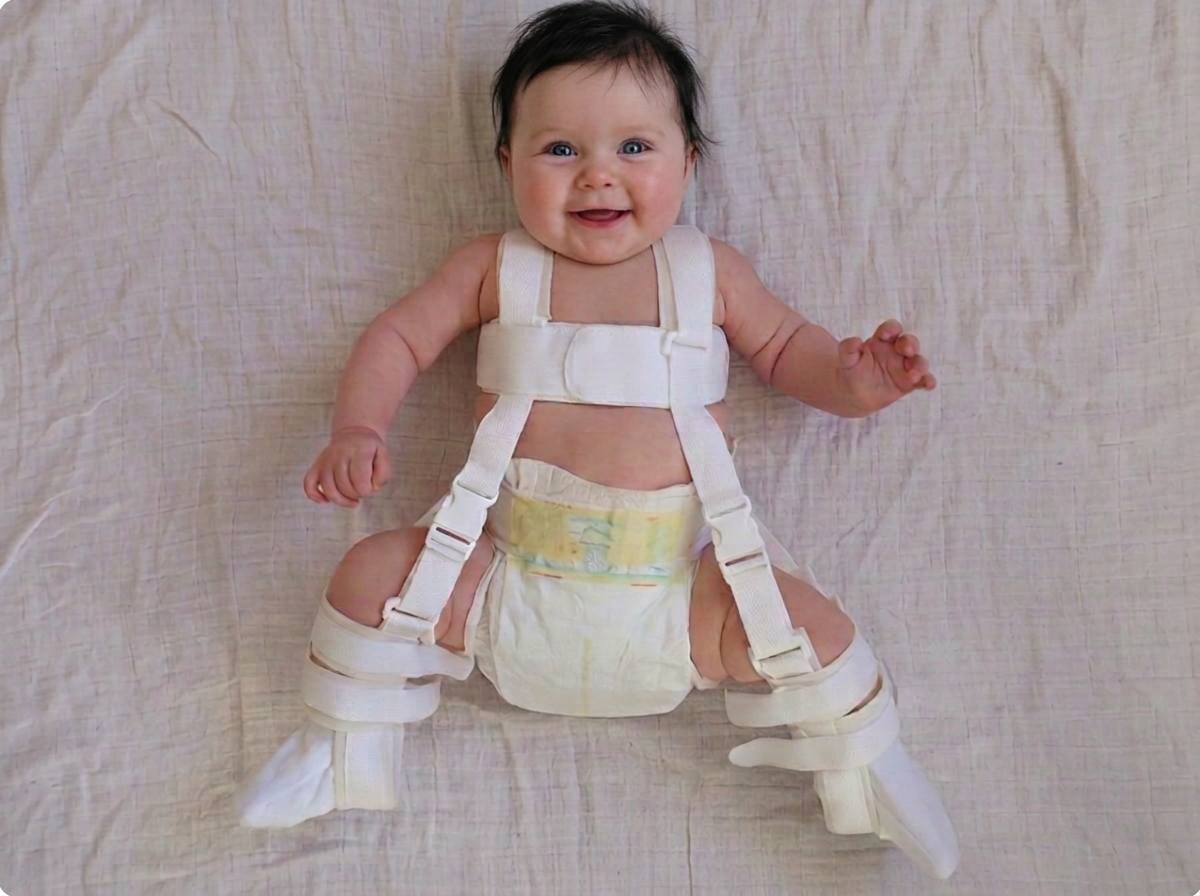
Once one child has been treated, the question every parent asks is what this means for the next baby. The honest answer: the risk is real and meaningfully higher than background, and it is entirely manageable with a scan.
Knowing the numbers takes most of the fear out of it.
The numbers
- Background risk in the general population: roughly 1-3 per 1,000 babies need treatment.
- One affected sibling: risk rises to roughly 6 percent.
- One affected parent: roughly 12 percent.
- One affected parent and one affected sibling: roughly 36 percent.
- Add breech presentation or female sex and each of these figures rises further.
What is actually inherited
Not a single gene — DDH is polygenic. What runs in families is generalised ligament laxity and the shape of the acetabulum. That is why an affected parent passes on a tendency rather than a certainty, and why identical twins are far more often both affected than fraternal twins.
What to do for the next baby
- Tell the midwife and paediatrician about the family history at booking, not after delivery.
- Request a hip ultrasound at around six weeks of age regardless of the newborn examination.
- Note the presentation in late pregnancy — breech plus family history is the highest-risk combination.
- Swaddle hip-safely from day one and use a wide-based carrier.
- Do not wait for symptoms; DDH is painless in babies.
Older siblings and cousins
If a first child is diagnosed after infancy, it is reasonable to ask about examining older siblings, particularly if anyone has an unexplained limp, leg length difference or waddling gait. Adult family members with early hip pain or a hip replacement before fifty may also have had undetected dysplasia.
Frequently asked questions
Is hip dysplasia hereditary?
Partly. It is polygenic — what is inherited is ligament laxity and socket shape. A sibling of an affected child has roughly a 6 percent risk, and a child of an affected parent roughly 12 percent.
Should my next baby be scanned?
Yes. A first-degree family history is a recognised indication for hip ultrasound at around six weeks, whatever the newborn examination shows.
Can I prevent it?
You cannot change genetics or in-utero position, but hip-safe swaddling, wide-based carriers and early screening are all within your control.