
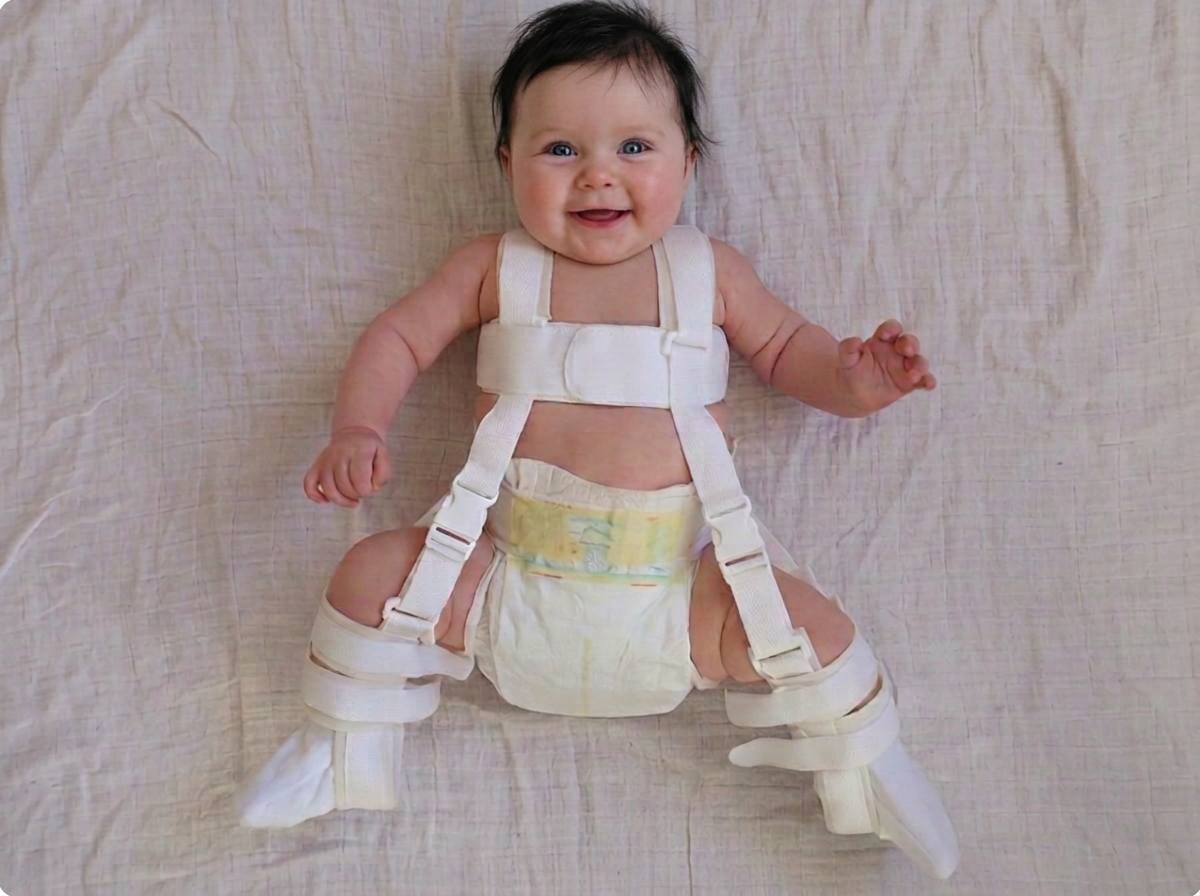
They are not the same, and they are not alternatives you choose between. A Pavlik harness is the first-line, soft, removable treatment for young babies. A spica cast is the rigid, surgical-theatre treatment used when the harness is not suitable or has not worked.
Knowing what separates them makes it much easier to follow what your surgeon is proposing.
Side by side
- Age: harness 0-6 months; spica any age, typically 6-18 months or after failed harness treatment.
- Material: harness is fabric webbing; spica is fibreglass over padding.
- Movement: harness allows kicking within a safe arc; spica immobilises the hips completely.
- Application: harness is fitted in clinic; spica is applied under general anaesthetic.
- Removal: harness may be removed for bathing once permitted; spica is not removable at home.
- Duration: harness typically 6-12 weeks full-time; spica typically 12 weeks with cast changes.
- Hygiene: harness is washable; spica must be kept dry and is cleaned around the edges only.
Why the harness is tried first
The harness is gentler on the blood supply to the femoral head, allows movement that helps mould the socket, needs no anaesthetic, and can be adjusted week to week as the baby grows. When it works — 85-95 percent of reducible hips treated early — it avoids theatre entirely.
Why a surgeon moves to a spica
- The hip has not reduced on ultrasound after about three to four weeks in the harness.
- The hip reduces but will not stay reduced.
- The baby was diagnosed after around six months of age.
- There is significant muscle imbalance, contracture or a syndrome affecting ligaments.
- The family cannot maintain the required hours of wear, making the harness unreliable.
What a spica involves
Closed reduction under general anaesthetic, an arthrogram to confirm the position, then a cast from chest to ankles with an opening for nappies. Position is confirmed with a CT or MRI in many centres. The cast is changed every six to eight weeks as the child grows, each change usually requiring another anaesthetic.
Daily life is a bigger adjustment: specialised car seats, feeding wedges, and careful nappy management. Most families report the first ten days are the hardest.
Does a failed harness mean surgery?
Not necessarily. Some surgeons move to a semi-rigid abduction brace first, and reduction under anaesthetic is not always followed by open surgery — a closed reduction is a manipulation, not an incision. Ask specifically which step is being proposed.
Frequently asked questions
Is a spica cast the same as a Pavlik harness?
No. A harness is soft, adjustable and allows movement; a spica is a rigid cast applied under anaesthetic that immobilises the hips.
Is a spica cast a sign treatment failed?
It means the harness route was not suitable or not sufficient. Outcomes after spica treatment for DDH are still very good.
Can a baby go back into a harness after a spica?
Sometimes a soft or semi-rigid abduction brace is used after the cast during weaning, but the harness itself is usually not reintroduced.