
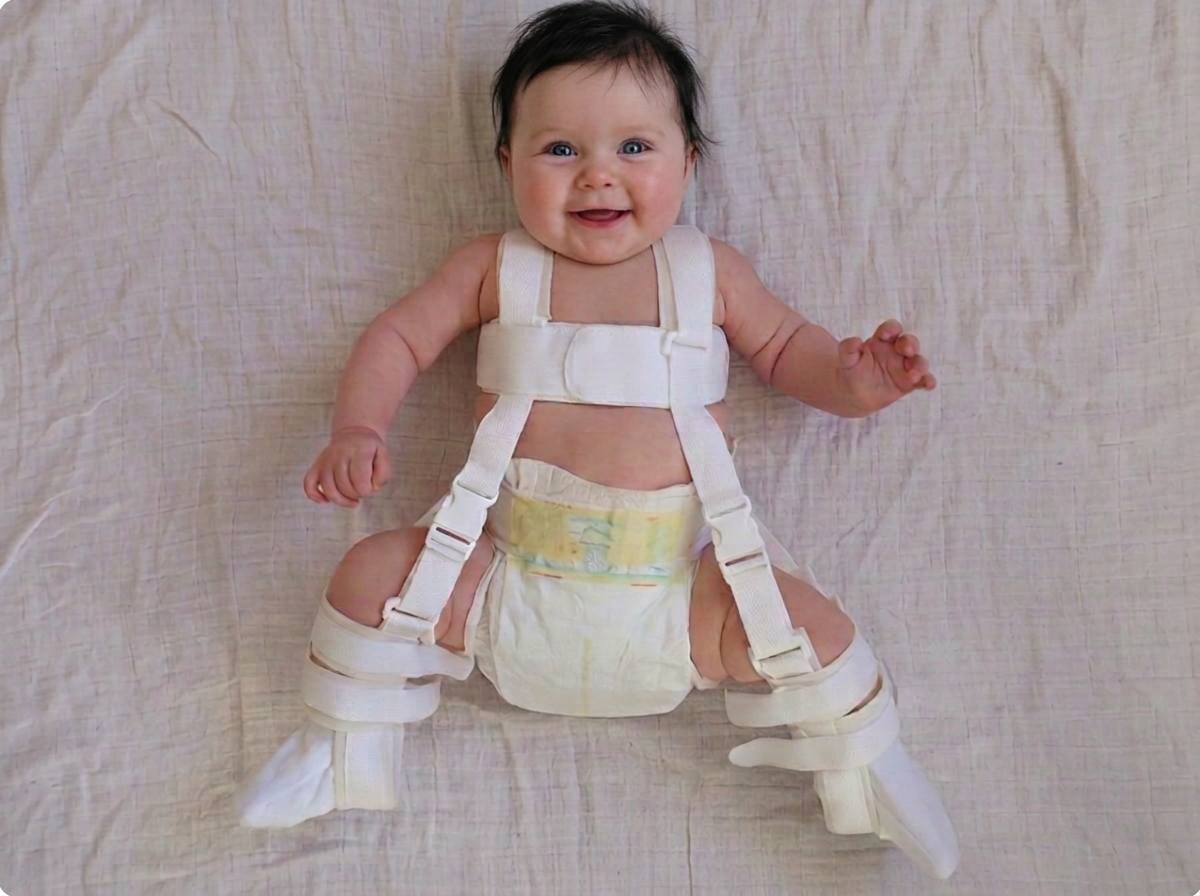
This is the question every parent asks at the two-week mark. The honest answer has two halves: there are real signs you can watch for at home, and there is only one thing that actually proves the hip is reducing — imaging.
Here is how to read both.
What only ultrasound can tell you
Success means the femoral head sits centred in the socket and the socket is deepening. That is measured by the alpha angle on ultrasound. An alpha angle rising toward and past 60 degrees over successive scans is the definitive sign the treatment is working.
Nothing you can see at home substitutes for this. A comfortable baby in a badly positioned harness looks exactly like a comfortable baby in a correctly positioned one.
Home signs that things are going well
- The baby settled within the first three days and no longer resists the harness.
- Both legs kick actively and equally within the harness's range.
- Thigh and buttock creases are becoming more symmetrical over the weeks.
- No skin breakdown, and any redness fades quickly after a position change.
- Feeding, weight gain and sleep have returned to their pre-harness pattern.
- The straps stay where the clinic set them between appointments.
Signs that need a call before the next appointment
- One leg has stopped kicking, or moves noticeably less than the other.
- You can no longer spread one leg as far as the other during a nappy change.
- A visible or palpable clunk when the leg moves.
- The knee on one side sits at a clearly different height when the baby lies flat.
- Straps repeatedly slipping out of position, or the harness feeling loose.
- Any skin breakdown under a strap.
The three-week rule
Most protocols allow about three to four weeks of full-time wear to demonstrate reduction. If the hip has not reduced on ultrasound by then, continuing the harness is not neutral — a persistently dislocated hip held in the harness can deform the back edge of the socket, a problem clinicians call Pavlik harness disease. This is why surgeons stop the harness rather than persist when the scan shows no progress.
What progress usually looks like on the calendar
- Week 1-2: first check ultrasound; hip should be reduced in the harness.
- Week 3-4: alpha angle beginning to improve; strap adjustment for growth.
- Week 6-8: socket clearly deepening; discussion of weaning may begin.
- Week 8-12: alpha angle normal; weaning to nights and naps.
- Discharge: final scan or X-ray, plus a follow-up X-ray around walking age.
Frequently asked questions
My baby seems happy — does that mean it is working?
Comfort is a good sign for tolerance, not proof of reduction. Only ultrasound confirms the hip is in the socket and the socket is deepening.
How soon should the hip reduce?
Usually within the first one to three weeks of full-time wear. Most surgeons reassess the plan if there is no reduction by three to four weeks.
Do the leg creases have to become symmetrical?
They often do improve, but asymmetric creases can persist in healthy hips and can be absent in dysplastic ones. Treat them as a prompt to ask, not as a verdict.