
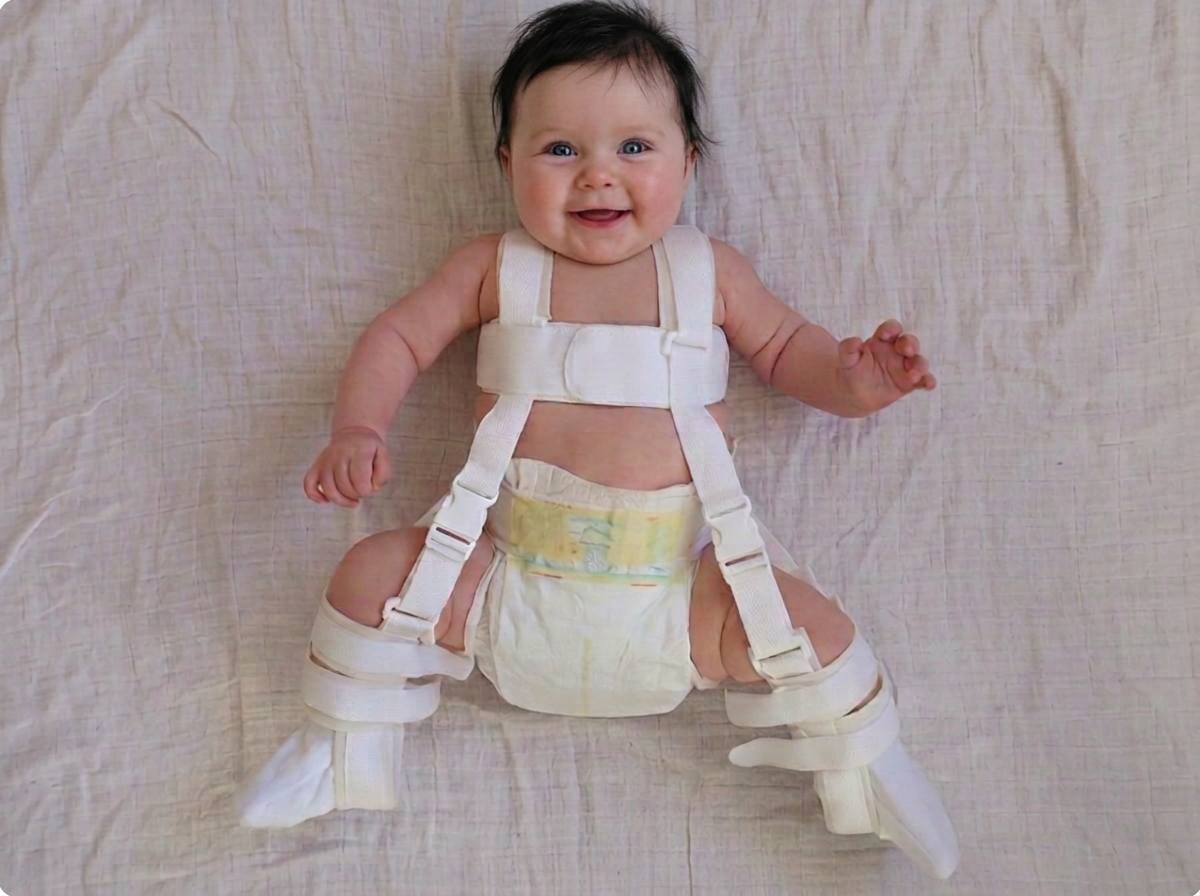
The Pavlik harness is the gentlest effective treatment for infant hip dysplasia, and serious complications are uncommon. They are not zero, and knowing what to look for is part of using it safely.
Every complication below is either preventable or reversible when caught early — which is the entire reason for frequent reviews.
Skin irritation and pressure areas — common, minor
The most frequent problem by far. Redness in the popliteal creases behind the knees, at the shoulders and under the chest strap. Prevented by a thin cotton layer under the harness, keeping skin dry, and twice-daily checks.
Redness that fades within twenty minutes of a position change is fine. Redness that persists, breaks the skin, or smells needs a call the same day.
Femoral nerve palsy — uncommon, reversible
Excessive hip flexion can compress the femoral nerve, and the baby stops actively straightening the knee on that side. Reported in roughly 2 percent of treated babies. It is why every clinic review includes checking that both legs kick.
Treatment is simply reducing the flexion angle or pausing the harness; recovery is almost always complete within days to a few weeks. Call the clinic the same day if a leg stops kicking.
Avascular necrosis — rare, serious
Forced or excessive abduction can compress the blood supply to the femoral head. Modern protocols keep abduction to 50-70 degrees precisely to avoid this, and rates are low (commonly quoted under 1-2 percent with correct technique).
This is the reason strap settings are a clinical decision and not something to adjust at home, and why 'tighter must be better' is dangerously wrong.
Pavlik harness disease — preventable
If a dislocated hip is left in the harness for weeks without reducing, the femoral head presses on the back edge of the socket and deforms it, making later reduction harder. This is why surgeons stop the harness at three to four weeks if imaging shows no reduction rather than persisting.
Other issues parents notice
- Reflux and wind from hip flexion raising abdominal pressure — manage with upright feeding and frequent winding.
- Temporary delay in rolling and tummy time — resolves within weeks of removal.
- Overheating in warm weather — dress lighter, check skin more often.
- Fussiness in the first three days — nearly universal and short-lived.
Same-day red flags
- A leg that stops kicking or feels floppy.
- Broken skin, an open sore, or a foul smell under a strap.
- The harness has come off or a strap has moved and cannot be restored.
- Fever with redness under the harness.
- Inconsolable distress beyond the first three days, or refusal to feed.
Frequently asked questions
Is a Pavlik harness safe?
Yes, when fitted by a clinician with imaging confirmation and reviewed regularly. Serious complications are uncommon and most are preventable or reversible when caught early.
Does a Pavlik harness hurt the baby?
It should not. Correctly set, it holds a position babies adopt naturally. Persistent crying beyond the first few days suggests something needs checking.
What is Pavlik harness disease?
Deformity of the back edge of the socket caused by leaving a hip that will not reduce in the harness for too long. It is avoided by re-imaging early and changing plan at three to four weeks if the hip has not reduced.