
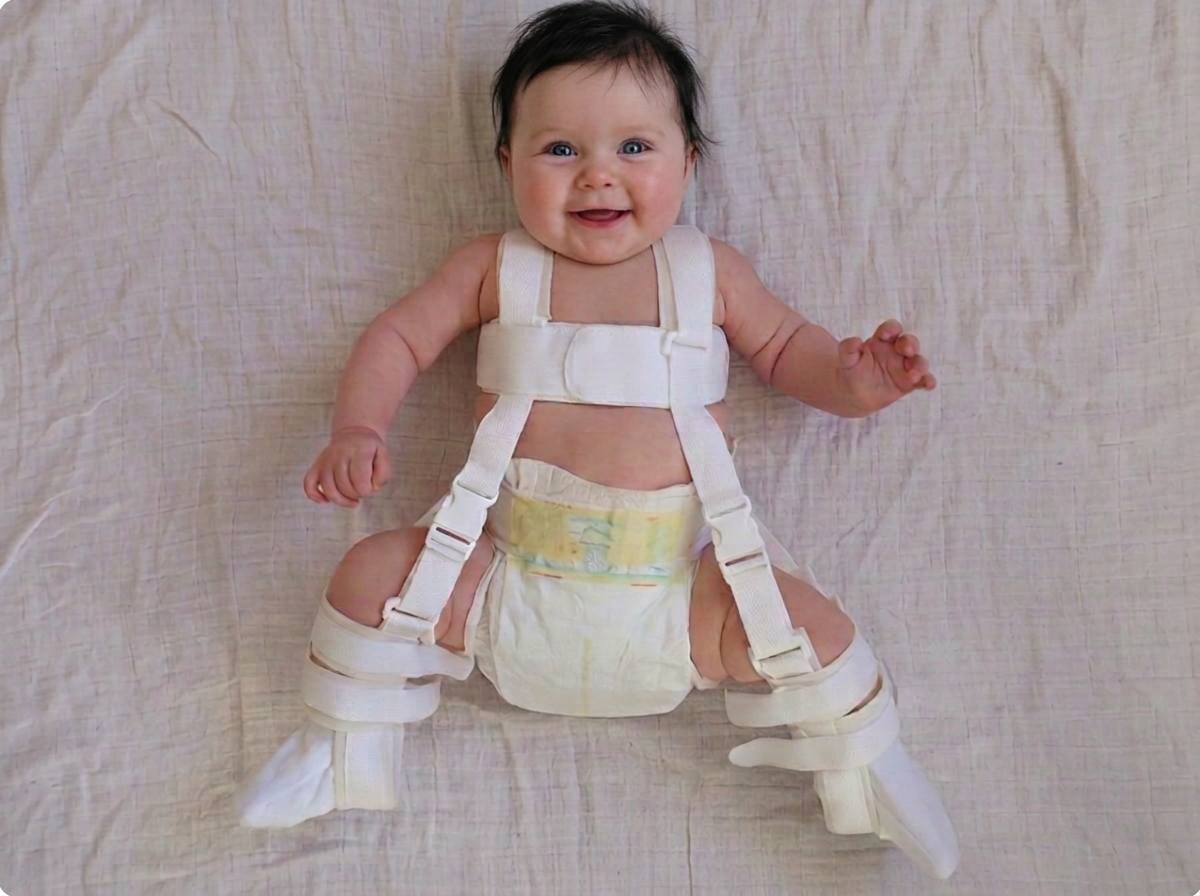
Parents watching a baby spend three months with the legs held up and apart understandably worry about milestones. The reassuring answer, consistently reported in follow-up studies, is that treated babies catch up and walk within the normal age range.
Some short-term lag is expected and temporary. Here is what is typical.
What is genuinely delayed, and for how long
Tummy time is harder in a harness, so head and neck strength can lag slightly during treatment. Rolling is usually delayed while the harness is on, simply because the mechanics are awkward.
After the harness comes off, most babies regain what was postponed within two to six weeks. Sitting, crawling and walking almost always land inside the normal range — walking typically between 10 and 18 months, exactly as for untreated babies.
Why the delay is temporary
The harness restricts range, not muscle development. The baby is still kicking, still bearing weight through the joint, and still building tone within the permitted arc. Once the restriction is removed, normal exploration resumes quickly.
There is also no evidence that harness treatment causes lasting gait abnormality when the hip has been successfully reduced.
Helping development during treatment
- Do tummy time with a rolled towel under the chest so the harness legs hang comfortably.
- Encourage side-lying play, which is easier than prone for many harness babies.
- Hold the baby upright at your shoulder often to build neck and trunk strength.
- Use high-contrast toys at eye level to encourage head turning and reaching.
- Avoid propped sitting devices and bouncers unless your clinic approves them.
After the harness comes off
Expect the legs to look bowed and to be held apart for a few weeks — the soft tissues have adapted. This settles on its own; stretching is not needed and should not be attempted. Babies often dislike lying flat with straight legs at first and prefer the frog position they are used to.
When to raise a concern
- No head control by four months corrected age.
- No rolling by six months after the harness has been removed.
- Not sitting unsupported by nine months.
- Not pulling to stand by twelve months.
- Persistent asymmetry — always using one side, or dragging one leg.
- Not walking by eighteen months.
Frequently asked questions
Will my baby walk late because of the harness?
Very unlikely. Follow-up studies consistently show babies treated in infancy walk within the normal 10-18 month window.
Why are my baby's legs bowed after the harness?
Soft tissues have adapted to the abducted position. It resolves spontaneously over several weeks. Do not stretch the legs.
Can we do physiotherapy during treatment?
Only what your clinic recommends. Unsupervised stretching or positioning exercises can work against the harness.