
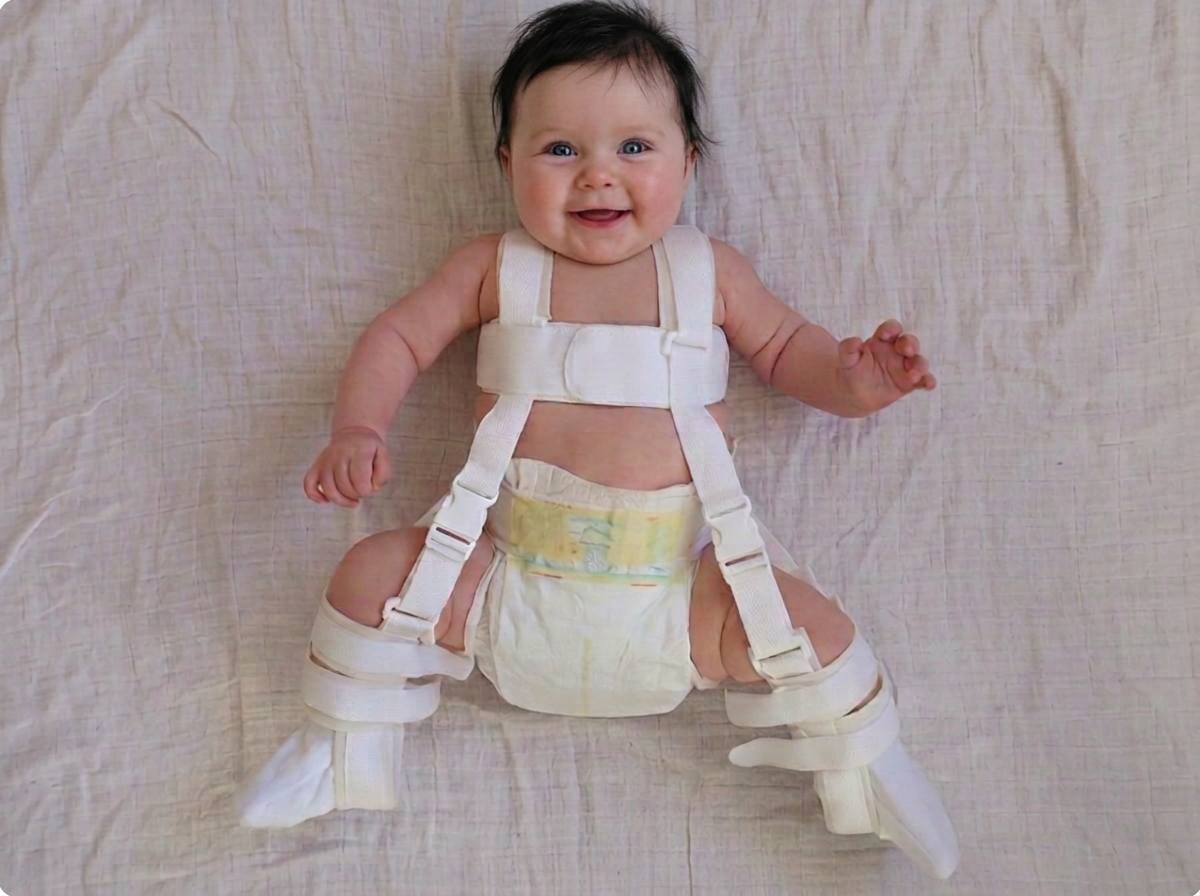
The last day in the harness feels like a finish line, and mostly it is. There is a short adjustment period, then a few appointments spread over years to make sure the hip keeps developing well.
Here is what the months and years after treatment look like.
The weaning schedule
Weaning is gradual, and it is decided by imaging rather than by the calendar. A common pattern is full-time wear until the socket is mature, then 16-18 hours a day for two weeks, then nights and naps for two to four weeks, then nights only, then stop. Some surgeons wean faster, some slower; follow yours precisely.
The first two weeks out of the harness
- The legs look bowed and are held apart — normal, and it resolves on its own.
- The baby may dislike lying flat with straight legs and prefer the frog position.
- Stiffness at the hips for a few days is common.
- Rolling and tummy time improve quickly once the restriction is gone.
- Do not stretch the legs straight; let the soft tissues settle naturally.
Long-term follow-up
Even a hip that looks perfect at discharge is normally X-rayed again around walking age, because a small proportion develop residual dysplasia — a socket that is slightly too shallow — which is silent in early childhood and much easier to correct if found early.
Many surgeons add a check in mid-childhood and, for hips that were severely affected, one near skeletal maturity. Keep every one of these appointments.
What to watch for as your child grows
- A limp, waddling gait, or toe-walking on one side.
- One leg appearing shorter, or a pelvis that tilts when standing.
- Reluctance to weight-bear, or hip or knee pain.
- A marked difference in how far each leg spreads.
- Any of these deserve a review even years after discharge.
Sport, activity and adulthood
Children treated successfully in infancy have no activity restrictions. They run, swim, cycle and play contact sport like anyone else. The reason follow-up matters is not fragility now, but that untreated residual dysplasia is a leading cause of hip arthritis in young adults — and it is preventable when caught in childhood.
Frequently asked questions
How long does weaning off a Pavlik harness take?
Usually two to six weeks, stepping down from full time to nights and naps and then nights only, guided by imaging.
Why are my baby's legs bowed after the harness?
Soft tissues adapted to the abducted position. It resolves spontaneously over a few weeks and needs no stretching.
Does my child need X-rays years later?
Most surgeons X-ray around walking age and sometimes again in mid-childhood, to catch residual dysplasia early. These checks are worth keeping.