
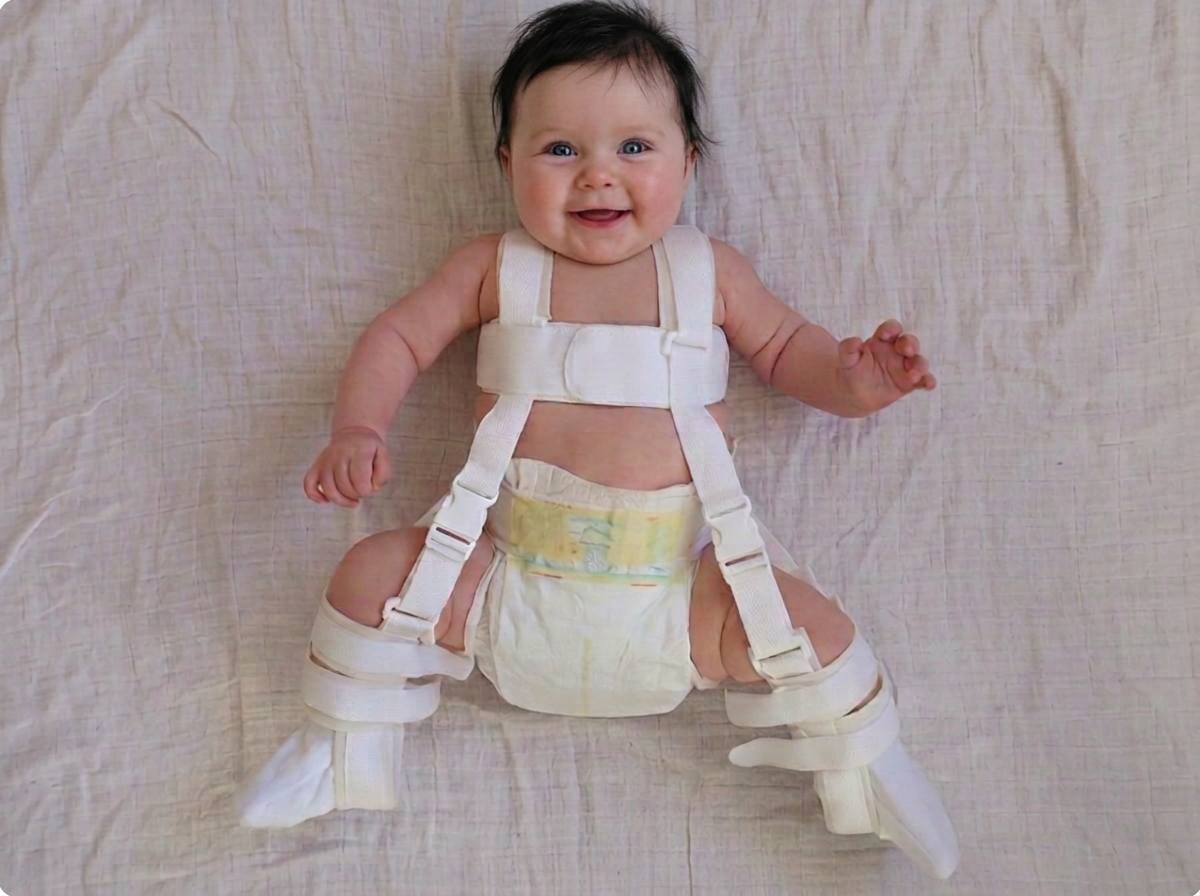
Parents almost always want two numbers: how likely is this to work, and how long will it take. The honest answers are 'usually' and 'about three months', with meaningful variation by severity and by how early treatment starts.
Success rates by severity
- Shallow but stable (dysplastic) hips: success above 95 percent.
- Subluxated hips: roughly 90 percent.
- Dislocated but reducible hips: roughly 80 to 90 percent.
- Irreducible dislocation: the harness is generally not attempted; closed reduction is the usual route.
What improves the odds
- Starting before six weeks of age.
- Wearing the harness for the full prescribed hours.
- Attending every review so straps stay correctly set as the baby grows.
- Early reporting of skin problems, so wear is never interrupted.
A typical timeline
Diagnosis and fitting in week 0. Ultrasound at one to two weeks to confirm reduction. Reviews every one to two weeks. Repeat ultrasound at six weeks. Weaning between weeks eight and twelve if imaging is satisfactory. X-ray at six months and again at twelve months, then usually one more at walking age.
After the harness
Most babies need no physiotherapy. Milestones such as rolling and sitting may lag by a few weeks and then catch up completely. Crawling and walking typically arrive within the normal range. Long-term, a hip treated successfully in infancy generally behaves like any other hip.
Follow-up continues to walking age because a small proportion of children develop residual dysplasia that is easiest to correct when caught early.