
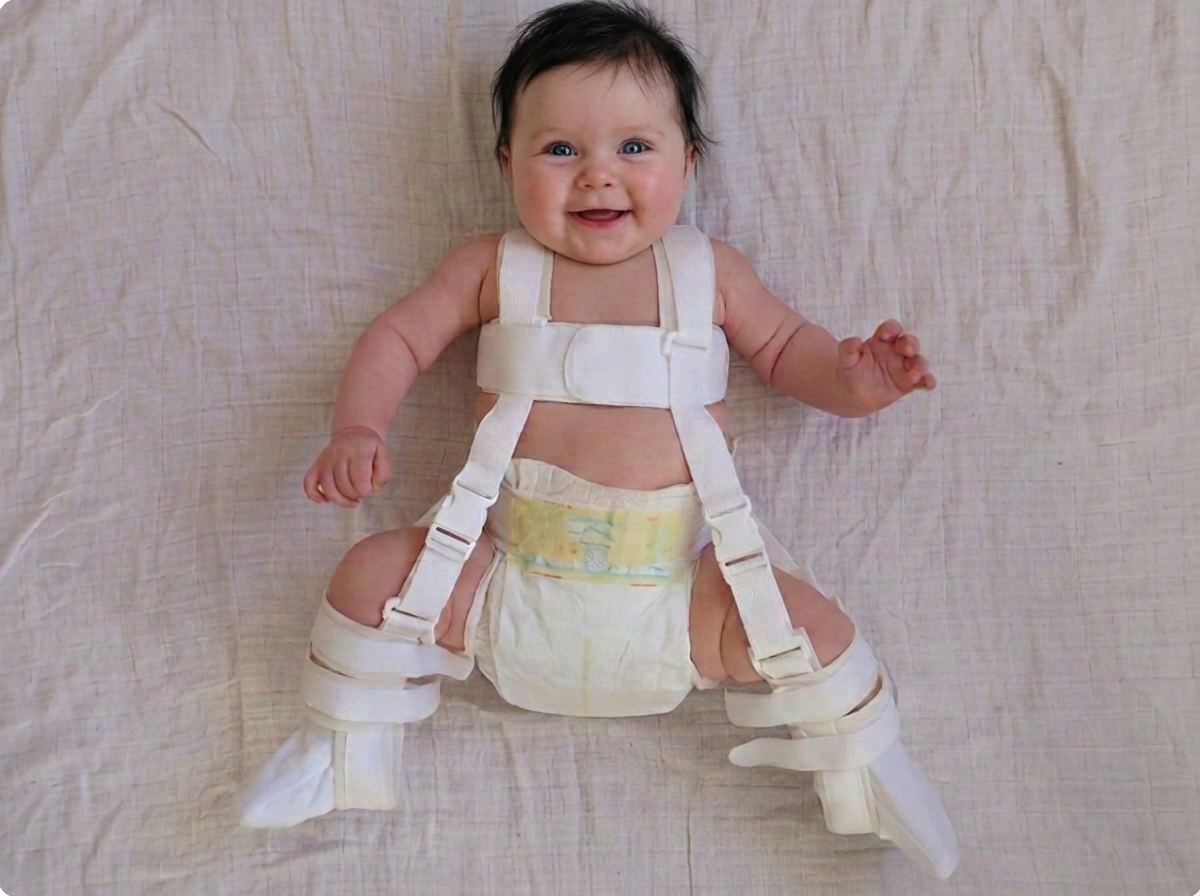
Ask any parent whose baby has worn a Pavlik harness what was hardest in daily life, and the answer is often the same: keeping it clean. Milk, dribble, nappy leaks and sweat all end up on straps that, in many treatment plans, are not allowed to come off for weeks.
That is why searches for Pavlik harness covers, Pavlik harness clothes and replacement harnesses are so common. This guide explains how covers and liners help, which fabrics are safe, how to clean the harness without changing the hip position, and when a spare harness is worth having.
Always follow your own orthopaedic team's instructions on whether the harness can be removed. Many teams ask for full-time wear in the early weeks, and the advice here works within that rule.
Why the harness gets dirty so fast
- Feeding: milk runs down the chin and soaks the chest strap.
- Nappy leaks: the leg straps and booties sit right next to the nappy.
- Sweat and warmth: the chest strap and shoulder crossover trap heat, especially in summer.
- Skin folds: babies' necks, armpits and the backs of the knees stay moist, and the straps sit right there.
Why you usually cannot just take it off
The harness holds the hip in a position where the socket can develop. Taking it off, even briefly, lets the hip move out of that position, and early in treatment that can slow or undo progress. Many teams ask for 23-24 hours a day of wear until the ultrasound shows stable hips; some allow a short daily bath. Only your clinician can tell you which applies to your baby.
That is why most of the cleaning work happens with the harness on: protecting the straps, spot cleaning, and changing what goes underneath.
Pavlik harness covers and liners: what they do
Covers are soft fabric sleeves that wrap around the chest strap and shoulder straps, usually closing with snaps or hook-and-loop. Liners or bibs sit between the harness and the skin. Both do the same job: they take the mess instead of the harness, and they can be swapped and washed in a minute without touching the strap settings.
Many parents buy several covers so a clean set is always ready. Small makers, including Etsy shops and specialist brands such as Little Hippy Co., sell covers made for Pavlik harnesses; check the fit against your harness before ordering.
Choosing safe covers and fabrics
- Choose soft, breathable cotton or bamboo jersey. Avoid thick fleece in warm weather.
- Covers must not change the strap length or add bulk that pushes the hips into a different position.
- No loose ties, long ribbons or small decorations that could become a choking or strangling risk.
- Seams should face away from the skin.
- Wash new covers before use with a fragrance-free detergent.
- Check the skin under covers at every nappy change for redness or rubbing.
Spot cleaning the harness while it stays on
- Blot fresh milk or leaks straight away with a damp cloth.
- Use a little mild baby soap on the cloth, then wipe with clean water. Do not soak the straps on the baby.
- Pat dry with a towel; a hairdryer on the cool setting, held well away, can speed up drying.
- Keep the skin under the straps clean and dry. Avoid powders and heavy creams under the straps unless your team recommends them.
- Never loosen or re-thread straps to clean them unless your clinician has shown you how and approved it.
Washing the harness itself
If your doctor allows the harness to come off, hand-wash it in lukewarm water with mild detergent, rinse well and air dry flat. Avoid tumble dryers and radiators, which can shrink fabric and warp fastenings. Mark the strap positions with a fabric pen before washing if they are not already marked, so you can restore the exact settings.
The problem is drying time. A wet harness can take hours to a full day to dry, and your baby cannot wait that long without one.
When a spare harness makes sense
A second harness of the same size lets you put a clean, dry one on while the other is washed. Families also keep a spare for travel, for nursery or a grandparent's home, or in case a strap or buckle is damaged.
Important: swapping harnesses is only safe if your doctor agrees and both harnesses are set to the same strap lengths. Ask your clinician to set or check the spare at a routine visit.
Our 'wear + spare' option on the product page adds two Baby Hip Pavlik Harness™ harnesses for $178, so the size and settings match. Shipping is free worldwide. All sales are final, so confirm the size with your doctor first.
Replacement harnesses: when the old one no longer fits
- The chest strap cannot be loosened enough to fit two fingers underneath.
- Shoulder straps press into the shoulders even at their longest setting.
- The booties are tight around the feet or calves.
- A buckle, strap or stitching is broken or frayed.
Clothing over the harness and covers
Dress your baby with the harness under the clothes. Simple layers work best: a short-sleeved vest or bodysuit under the harness (if your team allows), then loose sleepsuits or dresses on top, often a size bigger than usual. Avoid tight trousers and swaddles that pull the legs together. See our Pavlik harness clothing guide for detailed outfit ideas.
Frequently asked questions
Do I need covers for a Pavlik harness?
They are not essential, but most parents find they make life much easier because covers can be changed and washed without touching the harness settings.
Can I take the harness off to wash it?
Only if your doctor allows. Many teams require full-time wear in the early weeks. Spot clean while it stays on, and ask your team about a spare.
How do I keep a Pavlik harness from smelling?
Use washable covers, blot spills immediately, keep skin dry under the straps and wash or rotate the harness only as your doctor allows.
Is a spare Pavlik harness worth it?
For many families, yes: it allows washing without long gaps and helps with travel. It must be the same size and set to the same strap lengths by your clinician.
What should my baby wear under the harness?
Many teams allow a thin short-sleeved bodysuit or vest under the harness to protect the skin. Ask your clinician what they prefer.
How much is a spare harness?
Baby Hip Pavlik Harness™ costs $89 each, or $178 for two, with free shipping worldwide. All sales are final.
When does my baby need a bigger harness?
When the chest strap is tight even at its loosest setting, the shoulder straps dig in or the booties are snug. Your clinician will confirm.