
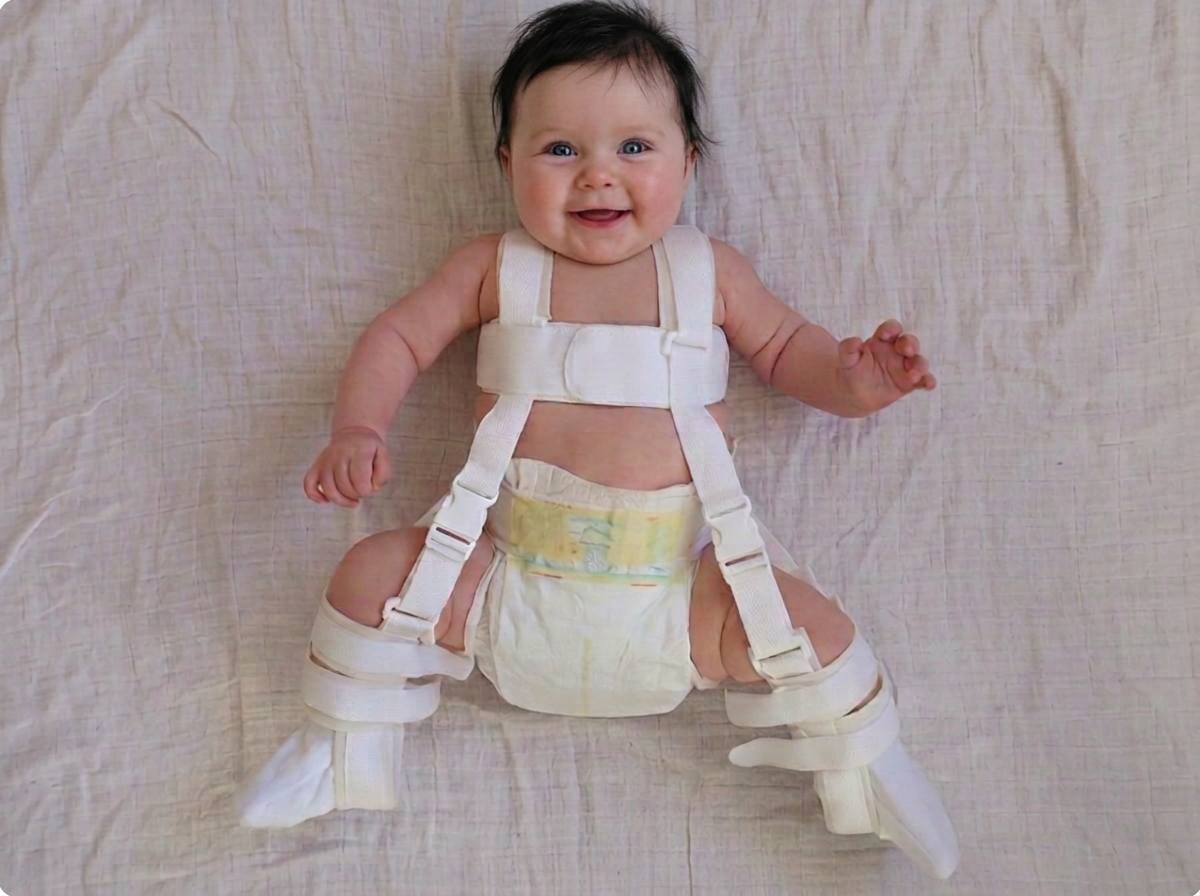
Most babies who need a Pavlik harness are fitted in the first weeks of life, often within days of a newborn hip screen. The first fortnight is the hardest part of the whole treatment — and almost always the only hard part.
Here is what actually happens, day by day, and what is normal versus what needs a phone call.
Day 0: the fitting appointment
A clinician measures the chest, fits the harness, and sets four strap groups: chest, shoulders, anterior (flexion) and posterior (abduction). Hip flexion is set to roughly 100-110 degrees and abduction to 50-70 degrees — never forced to the maximum. Ultrasound confirms the femoral head sits in the socket in that position.
Photograph the strap positions and the marks on the webbing before you leave the clinic. If a strap ever slips, that photo is how you know where it belongs.
Days 1-3: the settling period
Expect fussing. The position is new, the baby cannot straighten the legs, and sleep is disrupted. Extra skin-to-skin, more frequent short feeds, and carrying upright against your chest all help. Nearly every family reports that by day three the baby has stopped noticing the harness.
What is not normal in these days: refusing feeds entirely, inconsolable screaming that does not settle at all, or one leg that stops kicking. Those need a same-day call.
Days 1-14: feeding and winding
Newborns in a harness are more prone to reflux because the hips are flexed and the abdomen slightly compressed. Feed in a more upright position, wind more often, and keep the baby upright for ten to fifteen minutes after feeds. Breastfeeding is entirely possible — the rugby-ball hold and side-lying position both work well around the stirrups.
Days 1-14: skin
- Check behind the knees, the popliteal creases, the shoulders and the neck twice a day.
- Look for redness that does not fade within 15-20 minutes of a position change.
- Keep skin dry — moisture under a strap is what causes breakdown, not the strap itself.
- Use a thin cotton vest under the chest strap and thin cotton socks under the stirrups.
- Do not apply creams, powders or barrier ointments under the straps unless your clinic asks you to.
The first check appointment
Usually at one to two weeks. The clinician re-examines the hip, repeats the ultrasound, and adjusts the straps for growth. Babies grow fast in the first month and a harness that fitted at day zero is often loose by day ten. Never adjust straps yourself between appointments unless you were specifically taught to.
Call the clinic the same day if
- The baby stops kicking one or both legs, or a leg feels floppy.
- There is skin breakdown, an open sore or a foul smell under a strap.
- The harness has come off, or a strap has moved and you cannot restore it.
- The baby has a fever with redness under the harness.
- Feeding stops or the baby is inconsolable beyond the first 72 hours.
Frequently asked questions
Can my newborn sleep in the harness?
Yes, and they must — the harness is worn during sleep. Place the baby on their back on a firm flat surface, with no loose bedding, exactly as for any newborn. The bent-leg position is safe on the back.
Should I take the harness off if my baby cries?
No. Removing it, even briefly, is the most common cause of treatment failure. Settle the baby in the harness — upright carrying, skin-to-skin, feeding — and call the clinic if distress persists past 72 hours.
When can we bath the baby?
Only once your surgeon gives permission, which is usually at the first or second check. Until then, top-and-tail washing one area at a time keeps the harness on and dry.