
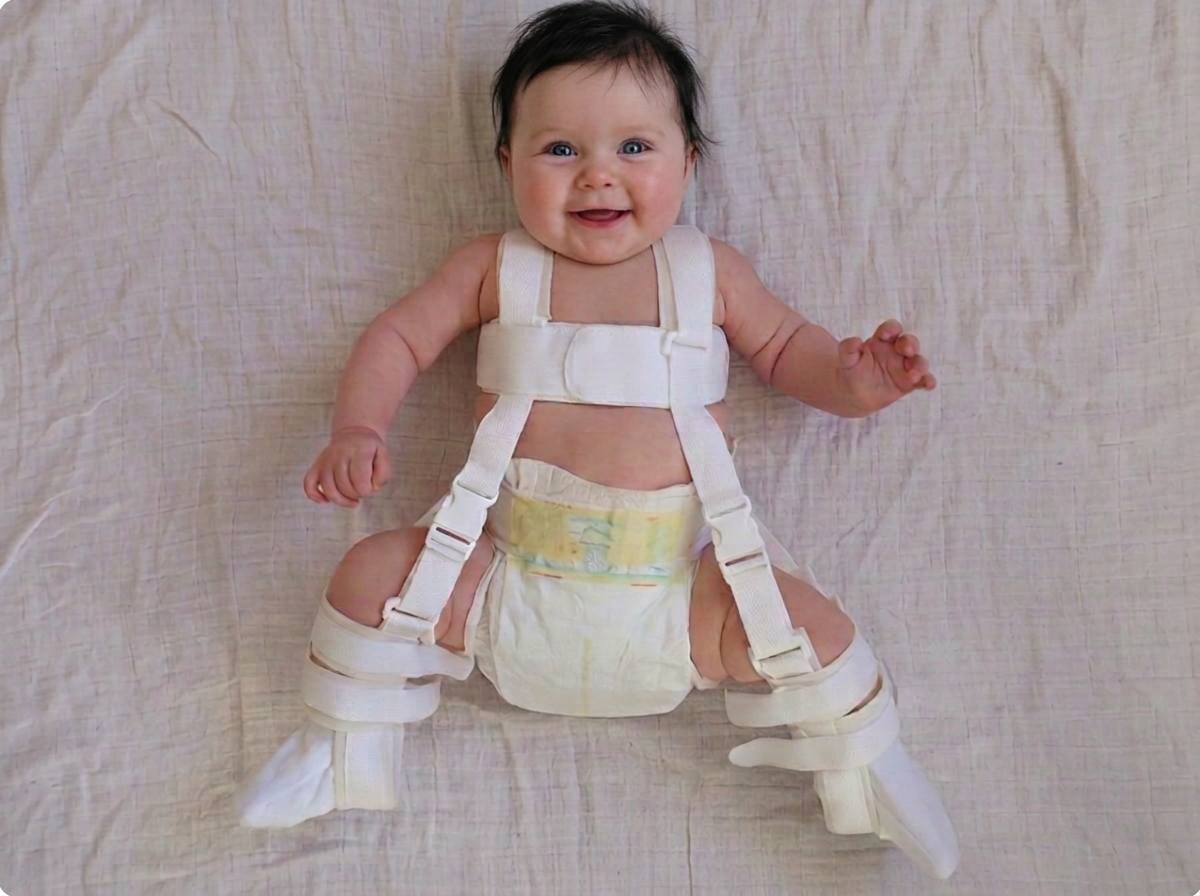
A harness does not ground you. Families travel, fly and drive long distances during treatment routinely — it just needs a little planning, especially around car seats.
The rule that never bends: the harness stays on for the journey.
Car seats
- Most rear-facing infant seats accommodate a harness; ask your clinic to check the fit once with your actual seat.
- Never thread the car seat straps through or around the harness straps — they are separate systems.
- The car seat harness must lie flat against the baby, not over bulky clothing.
- If the shoulder straps no longer sit at or just below shoulder level because of the harness, ask for a fit check rather than improvising.
- Break long drives every two hours so the baby is out of the semi-upright position.
Prams, slings and carriers
Lie-flat prams work well. Bucket-style seats with a narrow base are the ones to avoid, because they push the legs together against the treatment. Stretchy wraps and wide-seat carriers usually work beautifully — the harness position is exactly the M-shape they are designed for.
Airport security and flying
- You will not be asked to remove the harness. It is a medical device.
- Carry a letter from your clinic naming the device and diagnosis — one page is enough and prevents debate.
- Ask for a private screening if you prefer; you are entitled to one at most airports.
- Book a bassinet seat where possible; the spread-leg position needs a bit more width.
- Feed or offer a dummy on ascent and descent as you would normally.
What to pack
- Your clinic letter and the most recent ultrasound report.
- A photo of the correct strap positions on your baby.
- A spare harness if you have one, in hand luggage rather than the hold.
- Extra thin cotton vests and socks for under the straps.
- The contact details of your treating clinic, including out of hours.
Appointments and long trips
Treatment reviews happen every two to three weeks and imaging drives the plan, so avoid trips that would push an appointment more than a week. If you must travel longer, ask your surgeon whether a clinic at your destination can do an interim check and receive your notes.
Frequently asked questions
Can a baby fly in a Pavlik harness?
Yes. Airlines and airport security accept it as a medical device. Carry a clinic letter and keep the harness on throughout.
Do I need a special car seat?
Usually not. Most rear-facing infant seats fit around a harness, but have the fit checked once by your clinic or a car seat technician.
Can I remove the harness for a long journey?
No. Journey hours count as wear hours; removing the harness risks losing hip position.