
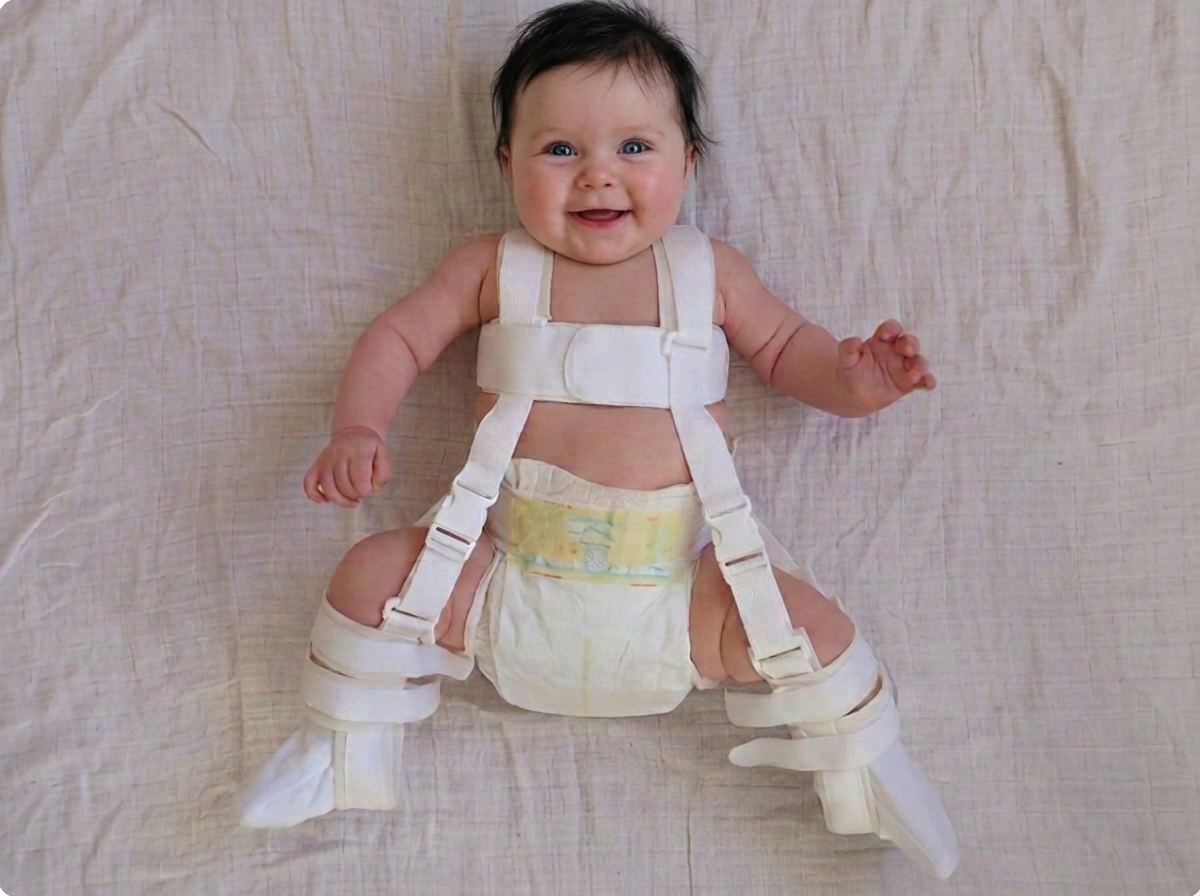
When parents start shopping for a Pavlik harness, one brand name comes up again and again: Wheaton. It is one of the best-known harness makers in the United States and is widely supplied through hospitals and medical equipment stores. That makes "Wheaton Pavlik harness" one of the most common searches families type after a diagnosis.
But Wheaton is not the only option, and the brand name on the strap matters far less than the size, the fit and whether your baby's doctor has confirmed the treatment plan. This guide explains what every Pavlik harness has in common, where models genuinely differ, how sizing works between makers, and the checklist we recommend before buying any hip dysplasia harness online.
This is a buying guide, not a replacement for your orthopaedic team. A harness only works when it is prescribed, sized and adjusted by a clinician who is following your baby's hips with ultrasound.
What every Pavlik harness has in common
The Pavlik harness was described by Arnold Pavlik in the 1950s, and the core design has barely changed. Every genuine Pavlik harness, whatever the brand, has the same four parts: a chest strap that sits around the upper chest, two shoulder straps that cross at the back, two leg stirrups or booties that hold the lower legs, and front (flexion) and back (abduction) straps that connect the stirrups to the chest strap.
Together these hold the hips bent to about 90-100 degrees and allow them to fall gently outwards. In that position the ball of the hip sits deep in the socket, and the socket can mould around it as the baby grows. The baby can still kick and move inside that safe range, which is why the harness is called a dynamic splint.
Because the mechanism is the same, a well-made harness from any reputable maker treats hip dysplasia the same way. Success rates reported in the medical literature, commonly above 90% for dysplastic but reducible hips treated early, come from the method and the follow-up care, not from one brand.
Where harness models genuinely differ
The differences between brands are practical. They affect comfort, cleaning and how easily the clinician can make adjustments:
- Fastenings: hook-and-loop (Velcro-style) straps are quick to adjust; buckles hold a setting more reliably and are harder for a growing baby to loosen.
- Strap markings: numbered or marked straps let parents put the harness back on at exactly the length the clinician set after a bath or change.
- Padding: soft lining around the chest strap and shoulder crossover reduces rubbing under the arms and on the neck.
- Bootie design: some models use an open stirrup, others a fuller bootie. Fuller booties spread pressure but can be warmer.
- Materials and washing: some fabrics dry in a few hours, others take a day. This matters if your doctor wants the harness worn around the clock.
- Size range: makers label sizes differently (for example by letters, numbers or baby weight), so a 'small' from one brand is not automatically a 'small' from another.
The Wheaton Pavlik harness at a glance
Wheaton Brace Co. is a long-established US maker of paediatric orthoses, and its Pavlik harness is a familiar sight in American hospitals. Parents often see it first because it is what their hospital fitted, or because it appears high in search results from medical supply stores.
If your baby is already in a Wheaton harness and doing well, there is no clinical reason to change brand mid-treatment unless your doctor suggests it. Many families who search for the Wheaton name are actually looking for a second harness, either as a spare for washing days or because their baby has grown into the next size. In both cases, what matters is matching the size and settings your clinician uses, not matching the logo.
We do not reproduce other makers' sizing charts or prices here because they change; check the current details directly with the supplier before comparing.
Hospital-issued, generic and Baby Hip Pavlik Harness™: how the options compare
- Hospital-issued harness: fitted by your team on the day of diagnosis. In public systems such as the NHS it is usually free; in US hospitals it is often billed with fitting and facility fees, which can add up to several hundred dollars.
- Medical supply stores: sell branded harnesses (including Wheaton) direct to families, typically around $90-$100 plus shipping in the US. Some only sell to clinics.
- Generic marketplace harnesses: cheaper, but quality, labelling and sizing are often unclear, and there is rarely anyone to ask clinical questions.
- Baby Hip Pavlik Harness™: our harness costs $89, with free worldwide shipping. It is designed and reviewed under paediatric orthopaedic surgeon Dr. Mutasem Aldhoon, comes with white soft-lined straps and marked settings, and is supported by the free guides and size calculator on this site.
Sizing: why you cannot swap brands by label alone
Pavlik harness sizes are based mainly on chest circumference and, to a lesser extent, the baby's weight and length. Because each maker draws its size boundaries differently, the safest approach is to measure your baby's chest just under the armpits and compare that number with the specific chart for the harness you are buying.
Babies grow quickly in the first months of treatment. Many need a larger harness partway through, especially if treatment started in the first weeks of life. If the chest strap can no longer be loosened enough to fit two fingers underneath, or the shoulder straps dig in at their longest setting, it is time to ask your clinician about the next size.
Use our Pavlik harness size calculator to check where your baby falls, and confirm the size with your orthopaedic team before ordering.
Your checklist before buying any hip dysplasia harness
- A doctor has confirmed the diagnosis (usually with hip ultrasound) and agreed that a Pavlik harness is the right treatment.
- You know the size your clinician wants, or you have measured the chest and confirmed it with them.
- Your clinician will fit or check the first fitting and set the strap lengths. Never guess the hip position yourself.
- The straps are marked so you can restore the exact settings after washing or changing.
- Padding protects the armpits, neck and the backs of the knees.
- You understand the seller's policy before you order. At Baby Hip Pavlik Harness™ all sales are final and we do not accept returns, so please confirm the size first.
- You have a plan for washing days: either strap-on cleaning, or a spare harness if your doctor allows swapping.
Is a brand-name harness more effective?
No good evidence shows that one well-made brand heals hips better than another. Studies of Pavlik treatment focus on timing, correct fitting, strap adjustment and how consistently the harness is worn. A harness that fits well, stays on and is checked regularly by your team is the one that works.
What a brand cannot fix: a harness worn too loose (the hips can slip out of position), front straps set too tight (risking nerve irritation or stress on the hip's blood supply), or missed follow-up ultrasounds. These are the factors that decide results.
When to buy a second harness
The most common reasons families order their own harness are a spare for hygiene, a larger size as the baby grows, travel, or a replacement after damage. Read our guide to Pavlik harness covers, liners and spare harnesses for how families manage cleaning days, and ask your doctor before you swap harnesses yourself.
Frequently asked questions
Is the Wheaton Pavlik harness the best?
Wheaton is a well-known, reputable maker, but no brand has been shown to heal hips better than other well-made Pavlik harnesses. Correct size, fitting by your clinician and consistent wear matter far more than the brand.
Can I replace a Wheaton harness with a different brand?
Often yes, but only with your doctor's agreement. Sizes differ between makers, so measure the chest and have your clinician set the straps on the new harness.
How much does a Pavlik harness cost?
Bought direct, most harnesses cost roughly $60-$150. Hospital billing in the US can be several hundred dollars. Baby Hip Pavlik Harness™ costs $89 with free shipping worldwide.
Do I need a prescription to buy a Pavlik harness?
You can buy one online, but you should only use it after a doctor has confirmed the diagnosis and the size. The harness must be fitted and followed up by your orthopaedic team.
What size Pavlik harness does my baby need?
Size is based mainly on chest circumference measured just under the armpits. Use the size calculator on this site and confirm with your clinician.
Can I return a harness if it is the wrong size?
Policies vary by seller. At Baby Hip Pavlik Harness™ all sales are final and returns are not accepted, so please confirm the size with your doctor before ordering.
How long will my baby wear the harness?
Typically 6-12 weeks, often full time at first and then weaned, depending on ultrasound progress. Your doctor decides.
Does a hip dysplasia harness hurt?
A correctly fitted harness should not hurt. Babies usually settle within a few days. Tell your team about redness, swelling, crying with movement, or if a leg stops kicking.