
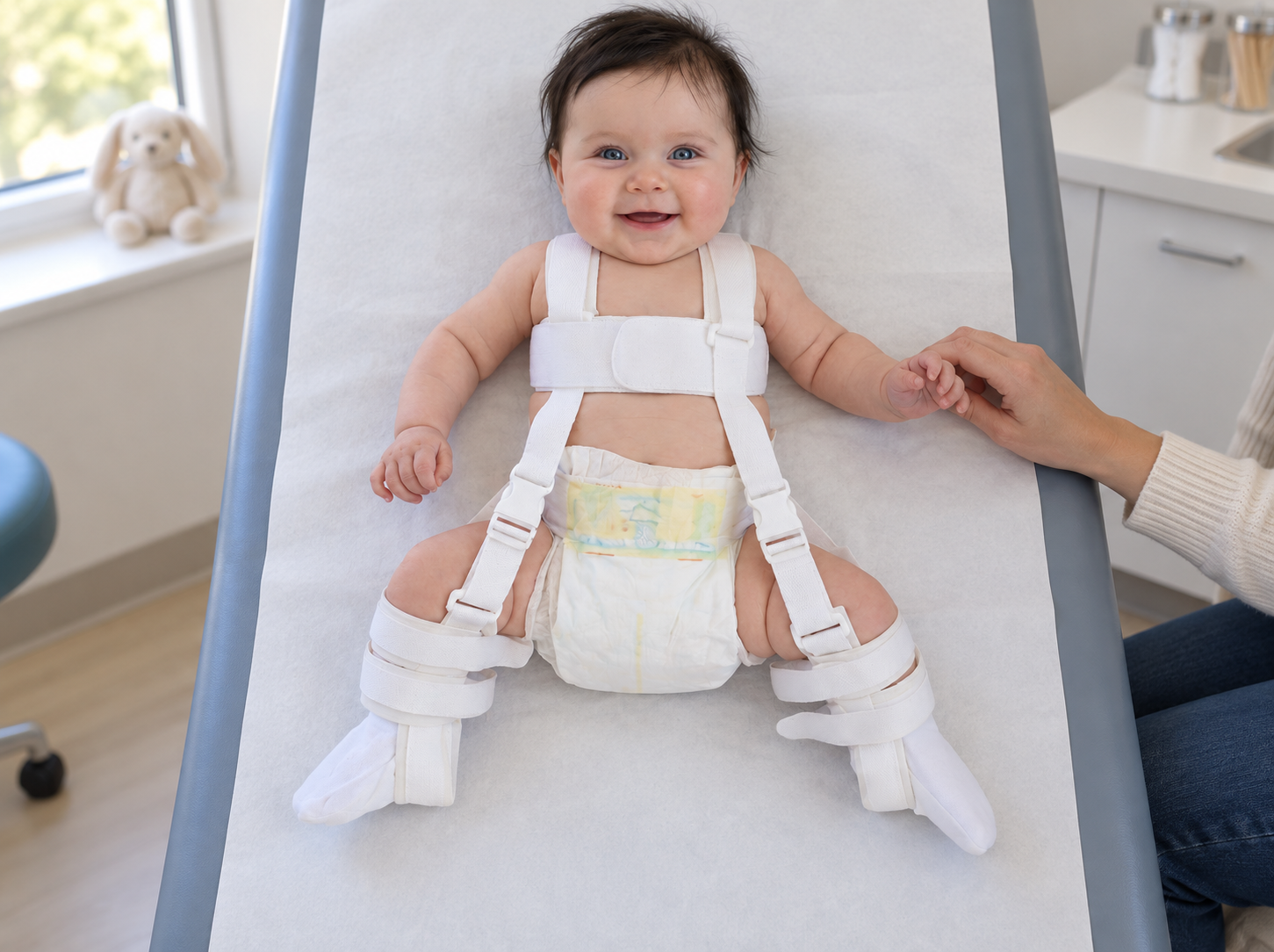
If your baby's doctor has mentioned a hip dysplasia brace, the next questions are usually practical: Which brace? What size? Can my baby sleep in it? And should I buy one myself or wait for the clinic? Before you order, the most important answer is this: a brace is part of a supervised treatment plan, not something to choose by age, a photograph or a low price alone.
A Pavlik harness is a soft brace used for some infants with developmental dysplasia of the hip (DDH). It supports the hips in a bent, naturally spread position while allowing movement. Other babies need observation, a different brace or another treatment. Your orthopaedic team decides from the examination and imaging, not simply from the words 'hip dysplasia' on a report.
This guide brings the buying decision and the first week of care together. It is general education based on the hospital and professional guidance linked below, not a diagnosis or an individual fitting prescription. We sell Baby Hip Pavlik Harness™ products, so our product mentions are commercial, not independent recommendations. Clinical review of this new article is pending.
The short answer: what to do before buying a baby hip brace
If you are still waiting for a diagnosis, do not start bracing to be safe. A clicking hip, uneven skin folds or a breech birth may prompt a check, but none tells you which treatment to buy. Bring the concern to your baby's clinician and follow their screening plan.
- Ask your clinician whether your baby needs treatment now and which exact brace they recommend.
- Check whether the clinic supplies the brace or whether you need to purchase it separately.
- Confirm the manufacturer-specific size and arrange a professional fitting before first use.
- Get written instructions for wear hours, washing, removal and the next appointment.
- Check the full delivered price and the seller's returns policy before paying.
What does a hip dysplasia brace actually do?
The hip is a ball-and-socket joint. In DDH, the socket may be shallow or the ball may not sit securely within it. A suitable brace positions the hip so the ball can remain in contact with the socket as the joint develops. The diagnosis can affect one hip or both; a harness supporting both legs does not mean both hips are abnormal.
The Pavlik harness uses a chest band, shoulder straps and leg supports. The clinician sets the straps to support the baby's hips and knees in the intended position. The legs are not supposed to be forcibly pulled apart. Avoid clothing, swaddles or carrying positions that squeeze the thighs together against the harness.
A comfortable-looking baby is not proof that the hip is improving. Ultrasound or other imaging and follow-up examinations are how your team assesses the response. Similarly, a baby who becomes upset is not a reason to tighten straps or invent a new position at home.
Pavlik harness, rigid brace or cast: which does my baby need?
A Pavlik harness is often used in young infants, particularly in the first six months, when the specialist considers the hip suitable for this approach. Age is only part of that decision: stability, hip position, imaging and response to treatment all matter. Some mild findings are monitored rather than braced immediately.
Rigid abduction braces hold the hips differently and may be used in selected situations. A spica cast is not an interchangeable shop-bought brace: it may be used after a procedure to put the hip back in place. Older babies and hips that do not respond to a harness can need a different pathway.
Do not substitute one device for another because both are advertised as 'hip dysplasia braces'. Ask for the exact device name and whether your clinician is happy to fit the model you plan to buy. Our existing brace-types guide explains the differences in more detail.
How to choose the right Pavlik harness size
Size labels are not universal. A small from one maker may not fit like a small from another. Use the chart for the actual product, and ask your team which measurements they want. Chest circumference, weight and age can be useful, but a measurement cannot replace an assessment of the complete fit.
For our harness, the published chest ranges are Small 33–38 cm, Medium 38–44 cm and Large 44–50 cm. If a measurement is near a boundary, ask your clinician which size to use rather than automatically choosing the larger one. Do not use these ranges to select another manufacturer's brace.
Our size calculator is a starting point for discussing an order, not a medical fitting tool. Tell your team the chest measurement and the product you intend to buy. If your baby is outside the listed ranges, do not force a fit; ask about another suitable device.
A larger harness is not necessarily better value. Excess material or an unsuitable size can make it harder to achieve the intended position. Growth during treatment is a reason for reassessment, not permission to move to a new size or copy the old strap lengths without a clinician checking them.
How much does a baby hip dysplasia brace cost?
The device price is only one part of treatment. Ask separately about fitting appointments, imaging, follow-up visits and any insurance requirements. A clinic may supply a harness through its service; buying one online does not automatically make these other costs disappear or guarantee reimbursement.
Our Baby Hip Pavlik Harness™ is $89 USD. Shipping is free worldwide, so one harness including shipping is $89 in every destination, before any applicable taxes or import charges. These figures are our store's prices, not a quote for treatment or a comparison of all suppliers.
All sales are final and returns are not accepted. Confirm the size, model and fitting arrangement before purchasing. If you need documentation for an insurer, ask them what they require before paying; we do not promise coverage.
Questions to ask at the first fitting appointment
Ask for a demonstration, then show the clinician what you have understood before leaving. Written instructions and clinic-approved setting marks are more useful than trying to remember everything during a stressful visit. A generic online photograph cannot show the correct settings for your baby's hips.
- Which parts may I touch, and which strap settings must stay unchanged?
- How many hours each day must the harness be worn, including sleep?
- Can it ever come off, and who should put it back on?
- What clothing can go underneath or over this particular model?
- How should I clean skin and straps if removal is not allowed?
- When is the next scan or fitting check, and whom do I contact between appointments?
- If I buy a spare, will you fit and check it separately?
Your first week: sleep, feeding, nappies and clothing
Sleep: continue established safe-sleep advice—place your baby on their back on a firm, flat, clear sleep surface. Do not add pillows, positioners or rolled towels to support the harness. Do not change prescribed wear hours for sleep without your team's approval. Ask your clinician if your baby has another condition affecting positioning.
Feeding and cuddling: you can usually continue holding and feeding your baby while supporting their body and allowing the legs to remain in the position the harness permits. Do not press the thighs together or lift the baby by the feet. If a usual feeding position feels awkward, ask your team to demonstrate a supported alternative.
Nappy changes: prepare everything first and keep the harness settings untouched. Avoid pulling the legs together or lifting both ankles to raise the bottom. Ask the team to show you a way to support the pelvis while replacing the nappy, keeping the straps clear of leaks.
Clothing: choose loose garments with room around the hips and knees. Tight trousers and straight-leg swaddling can work against the brace. Check with your clinic before adding layers beneath straps, because extra fabric can alter fit. Do not force a baby in a harness into a car seat that no longer accommodates them safely; seek advice about both brace positioning and the seat instructions.
Cleaning and spare harnesses: avoid interrupting treatment
Ask first whether removal is allowed. In early treatment, some babies must remain in their harness even when it is soiled. Follow the clinic's cleaning advice and the manufacturer's care instructions for the actual model; advice for another brand may not apply.
If you are allowed to wash the device, ask how treatment continues while it dries. A spare can be helpful only when your team approves changing between devices and checks the fit of each one. Two harnesses with the same label do not automatically have identical settings.
A replacement may be needed if the harness is damaged or no longer fits, but the decision should be made with your team. We offer a two-harness option for $178 with free worldwide shipping. It is optional, not a medical requirement and not a reason to remove the prescribed harness without permission.
When to contact the clinic promptly
Do not wait for the next scheduled visit if you notice a new problem. Contact the treating team promptly about reduced kicking or a leg that no longer moves as usual, persistent rubbing or broken skin, swelling, a slipping harness, damaged straps or a baby who seems in pain. Do not attempt to fix the problem by tightening or loosening the positioning straps yourself.
Seek urgent medical help if a foot becomes cold, pale or blue, your baby has trouble breathing, or your baby seems seriously unwell. General educational advice cannot determine whether a particular symptom is safe to wait on.
How long will my baby wear the brace?
Treatment often lasts weeks to months, but there is no single schedule suitable for every baby. The team may begin with full-time wear and later change the plan after reviewing hip development. Your baby's age, the initial findings and the imaging response influence that decision.
Do not stop because the legs look symmetrical, because your baby is comfortable or because another family finished sooner. Keep follow-up appointments even after the harness is discontinued; your specialist may want later imaging to check that the socket continues developing as your child grows.
Ready to order? Confirm these three things first
You have the clinician's agreement on this model, a confirmed size and an appointment or plan for fitting. Once those are in place, compare the delivered price and read the policy before paying. If you are unsure, bring the product details to your orthopaedic team rather than buying first and hoping it will work.
You can view our white Baby Hip Pavlik Harness™ and its size options using the product link below. Use the size calculator for preparation, and keep the treating clinician—not the shop—as the person making decisions about diagnosis, fit and wear.
Frequently asked questions
Is a Pavlik harness the same as a hip dysplasia brace?
It is one type of infant hip dysplasia brace. Other devices have different designs and indications; your specialist decides which is suitable.
Can I buy a hip brace before the ultrasound?
Do not start bracing without the treating clinician's diagnosis and plan. Ask the clinic whether you need a device and whether it supplies one.
Can my baby sleep in a Pavlik harness?
Follow prescribed wear hours, which may include sleep. Place your baby on their back on a firm, flat, clear sleep surface without positioners or pillows.
Will both legs be in the harness if only one hip is affected?
A Pavlik harness usually supports both legs. This does not mean both hips have dysplasia.
Can I change the straps as my baby grows?
Only make adjustments your treating team has explicitly taught and authorised. Growth and changes in fit should be checked by the clinician.
Do I need two Pavlik harnesses?
Not necessarily. A spare is optional and only useful if your team approves switching and fits each device. Ask how cleaning should work within your baby's wear plan.
How much is your harness with shipping?
One harness is $89 USD with free worldwide shipping ($89 total), before applicable taxes or import charges. All sales are final; returns are not accepted.
Practical guides for your next step
Sources
- Johns Hopkins Medicine — Pavlik harness treatment for children
- Royal National Orthopaedic Hospital — Patient guide to Pavlik harness treatment
- International Hip Dysplasia Institute — Pavlik harness tips for parents
- NHS — Developmental dysplasia of the hip
- American Academy of Orthopaedic Surgeons — Infant DDH clinical practice guideline