
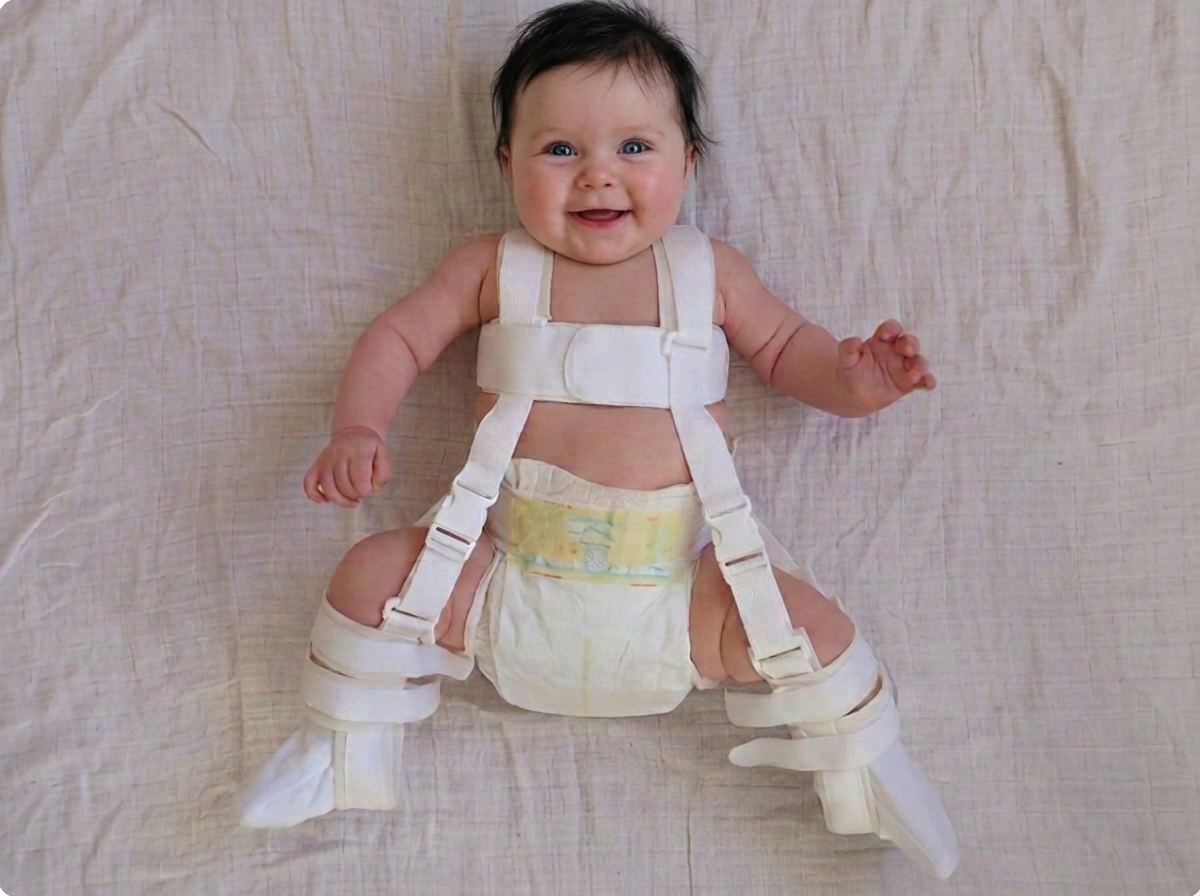
Hearing that your baby may have hip dysplasia is frightening, especially when your baby seems perfectly happy and pain-free. The good news is that hip dysplasia found in the first months of life is one of the most treatable conditions in paediatric orthopaedics. Most babies diagnosed early are treated with a simple soft brace and go on to have completely normal hips.
This guide explains hip dysplasia in babies in plain words: what it is, the signs to look for, which babies are at higher risk, how doctors check newborn hips, how treatment changes with age, and what you can do at home today. It is written for parents and reviewed by a paediatric orthopaedic surgeon.
It is general information, not a diagnosis. If you are worried about your baby's hips, ask your paediatrician or family doctor to examine them and arrange an ultrasound if needed.
What is hip dysplasia in a baby?
The hip is a ball-and-socket joint. The ball is the top of the thigh bone (the femoral head) and the socket is part of the pelvis (the acetabulum). At birth both are made mostly of soft cartilage, and they shape each other as the baby grows. For the socket to grow deep and round, the ball needs to sit snugly in the middle of it.
In hip dysplasia, also called developmental dysplasia of the hip (DDH), this fit is not right. The socket may be too shallow, the ball may be loose and able to slide partly out (subluxation), or the ball may sit completely outside the socket (dislocation). The word 'developmental' is used because the problem can be present at birth or develop in the first months.
Hip dysplasia affects roughly 1 to 3 in every 1,000 babies badly enough to need treatment, and mild looseness is found in many more newborns at their first check. Much of this mild looseness settles on its own in the first weeks, which is why doctors often re-check before starting treatment.
Left untreated, a dysplastic hip can lead to a limp, a leg-length difference and early arthritis in young adulthood. Treated early, the outlook is excellent.
Signs of hip dysplasia in babies parents may notice
Many babies with hip dysplasia have no visible signs at all, which is why routine screening matters. Hip dysplasia does not usually cause pain in babies. When signs are present, they can include:
- Uneven skin folds on the thighs or buttocks. On its own this is common in healthy babies, but together with other signs it is worth checking.
- One leg looking shorter than the other when the baby lies on their back with knees bent.
- One hip that does not open out as far as the other during nappy changes (limited abduction). This is one of the more reliable signs after the first few weeks.
- One leg turning outwards more than the other.
- A clunk felt when the hip moves (a soft 'click' from ligaments is usually harmless; a deep clunk of the ball moving in and out is what doctors look for).
- In walking children: a limp, walking on tiptoe on one side, or a waddling gait when both hips are affected.
Which babies are at higher risk?
Babies with risk factors, especially breech position or family history, are usually offered a hip ultrasound at around 6 weeks of age even if the examination is normal.
- Breech position in late pregnancy, even if the baby turned before birth or was born by caesarean.
- A parent, brother or sister who had hip dysplasia.
- Girls, who are affected several times more often than boys.
- First babies, because the womb is tighter.
- Low amniotic fluid (oligohydramnios) or large birth weight.
- Other packaging conditions such as torticollis (tight neck) or certain foot deformities.
- Tight swaddling with the legs held straight and together after birth.
How doctors check a baby's hips
Newborn exam: within the first days, and again at about 6-8 weeks, the doctor gently moves each hip using the Barlow and Ortolani manoeuvres to feel whether the ball is loose or out of place. These tests take seconds and do not harm the baby.
Hip ultrasound: before about 4-6 months the hip is still cartilage, so ultrasound is the best test. It measures the depth of the socket (the alpha angle) and how well the ball is covered. Ultrasound is usually done after 4-6 weeks, because many loose newborn hips tighten up by then.
X-ray: from around 4-6 months, as bone starts to form in the ball, an X-ray becomes more useful than ultrasound.
Results are often described with the Graf classification: Type I is normal, Type II ranges from immature to mildly dysplastic, and Types III and IV mean the hip is partly or fully displaced. Your team will explain what your baby's numbers mean.
Hip dysplasia treatment by age
The earlier treatment starts, the simpler it usually is. This is the single biggest reason screening and early ultrasound matter.
- Birth to 6 weeks, mildly loose or immature hips: often watched and re-scanned, because many correct themselves.
- Confirmed dysplasia or unstable hips under about 6 months: a Pavlik harness is the standard first treatment worldwide.
- If the harness does not work, or the baby is a little older: a more rigid abduction brace may be tried.
- Around 6-18 months, or if bracing fails: closed reduction under anaesthetic, followed by a spica cast for several months.
- Older children or hips that cannot be reduced: open surgery, sometimes with reshaping of the socket or thigh bone.
The hip dysplasia brace: how the Pavlik harness works
The Pavlik harness is a soft fabric brace with a chest strap, shoulder straps and leg stirrups. It holds the hips bent and gently turned outwards, the position in which the ball sits deepest in the socket. The baby can still kick and move within that safe range, and the movement itself helps the socket deepen.
Most babies wear the harness full time for around 6-12 weeks, then part time while the hips are checked by ultrasound. Success rates are commonly reported above 90% for dysplastic but reducible hips when treatment starts early.
The harness must be fitted and adjusted by your orthopaedic team, who will check it every 1-2 weeks at first. Signs to report straight away include a leg that stops kicking, swelling or pressure sores, or a harness that no longer fits.
Sizing is based mainly on chest circumference. Our free size calculator helps you check the right size, and Baby Hip Pavlik Harness™ is available for $89 with free worldwide shipping. Please buy only after your doctor has confirmed the diagnosis and size.
What parents can do today
- Swaddle hip-safely: keep the swaddle loose around the hips so the legs can bend up and out, like a frog.
- Use carriers and slings that support the thighs from knee to knee, with hips spread and knees higher than the bottom (the M-position).
- Avoid devices that hold the legs straight and pressed together for long periods.
- Make sure your baby's hips are checked at the newborn and 6-8 week reviews, and ask about an ultrasound if your baby has risk factors.
- See a doctor promptly if you notice limited hip opening, a leg-length difference or a limp.
Long-term outlook
Babies whose hip dysplasia is found and treated early usually develop normal hips, crawl and walk at the usual ages, and grow up without restrictions. Most teams continue occasional X-ray checks until the child is older, because a small number of hips need further help as they grow.
Late-diagnosed hip dysplasia is harder to treat and is a leading cause of hip replacement in young adults, which is why awareness and early checks make such a difference.
Frequently asked questions
What are the first signs of hip dysplasia in a baby?
Often there are none, which is why screening matters. Possible signs include one hip not opening as far as the other, a leg that looks shorter, uneven thigh or buttock creases, and a clunk felt when the hip moves.
Does hip dysplasia hurt babies?
No, hip dysplasia is usually painless in babies. Pain is not a reliable sign, so check-ups and ultrasound are important.
Can hip dysplasia in babies correct itself?
Mild looseness in the first weeks often settles on its own, which is why doctors may re-scan at 6 weeks. True dysplasia that persists needs treatment.
How is hip dysplasia diagnosed in a newborn?
With a gentle hip examination at birth and at 6-8 weeks, and a hip ultrasound for babies with risk factors or abnormal findings.
Do uneven thigh folds mean hip dysplasia?
Not on their own. Many healthy babies have uneven folds. They are worth mentioning to your doctor, especially with other signs or risk factors.
What is the treatment for hip dysplasia in babies?
Under about 6 months, a Pavlik harness is the usual first treatment. Older babies or hips that do not respond may need a rigid brace, a spica cast or surgery.
How long does a baby wear a hip dysplasia brace?
Usually around 6-12 weeks full time, then part time, depending on ultrasound progress. Your doctor decides.
Can tight swaddling cause hip dysplasia?
Swaddling with the legs held straight and together raises the risk. Hip-healthy swaddling leaves room for the legs to bend up and out.
Is hip dysplasia more common in girls?
Yes, girls are affected several times more often than boys, along with first babies, breech babies and those with a family history.
Will my baby walk normally after hip dysplasia treatment?
When treated early, most children walk at the usual age and have normal hips. Follow-up X-rays check that the hips keep developing well.
Sources
- American Academy of Pediatrics — Evaluation and referral for DDH in infants
- International Hip Dysplasia Institute — Pavlik harness tips for parents
- NHS — Developmental dysplasia of the hip
- Johns Hopkins Medicine — Pavlik harness treatment for children
- The Royal Children's Hospital Melbourne — Pavlik harness for DDH