

Hearing that your newborn has a dislocated hip, or that a doctor felt a clunk during the baby check, is frightening. Most parents have never heard of the condition before that moment. The reassuring part: when a newborn hip problem is found early, treatment is usually gentle, non-surgical and very effective. Many babies treated in the first months of life go on to walk, run and play with normal hips.
A dislocated hip in a newborn is part of a condition called developmental dysplasia of the hip (DDH). It was once called congenital dislocation of the hip (CDH) or congenital hip dysplasia. Doctors now use the word 'developmental' because the hip can change in the weeks after birth: some loose hips tighten up on their own, while a few problems only appear later.
This guide explains what 'dislocated', 'dislocatable' and 'dysplastic' mean, the signs parents might notice, how doctors test a newborn's hips, which scans are used and when, how a Pavlik harness and other treatments work, and what recovery looks like. It is general education based on the hospital and professional sources listed at the end, not a diagnosis. Clinical review of this new article is pending. We sell Baby Hip Pavlik Harness™ products, so product mentions are commercial.
Quick answers for worried parents
If you only have a minute, these are the key points.
- A newborn hip dislocation means the ball at the top of the thigh bone sits outside the hip socket, or slips out easily.
- It is usually painless for babies, so a contented baby can still have a hip problem.
- Doctors check for it with gentle movements called the Ortolani and Barlow tests, then confirm with an ultrasound in young babies.
- Some loose hips at birth stabilise by themselves within weeks. A hip that stays out of the socket needs treatment.
- The most common first treatment in young babies is a soft brace called a Pavlik harness, fitted and checked by a specialist.
- Early treatment matters: it is simpler and more successful in the first months than after a baby starts walking.
What is a dislocated hip in a newborn?
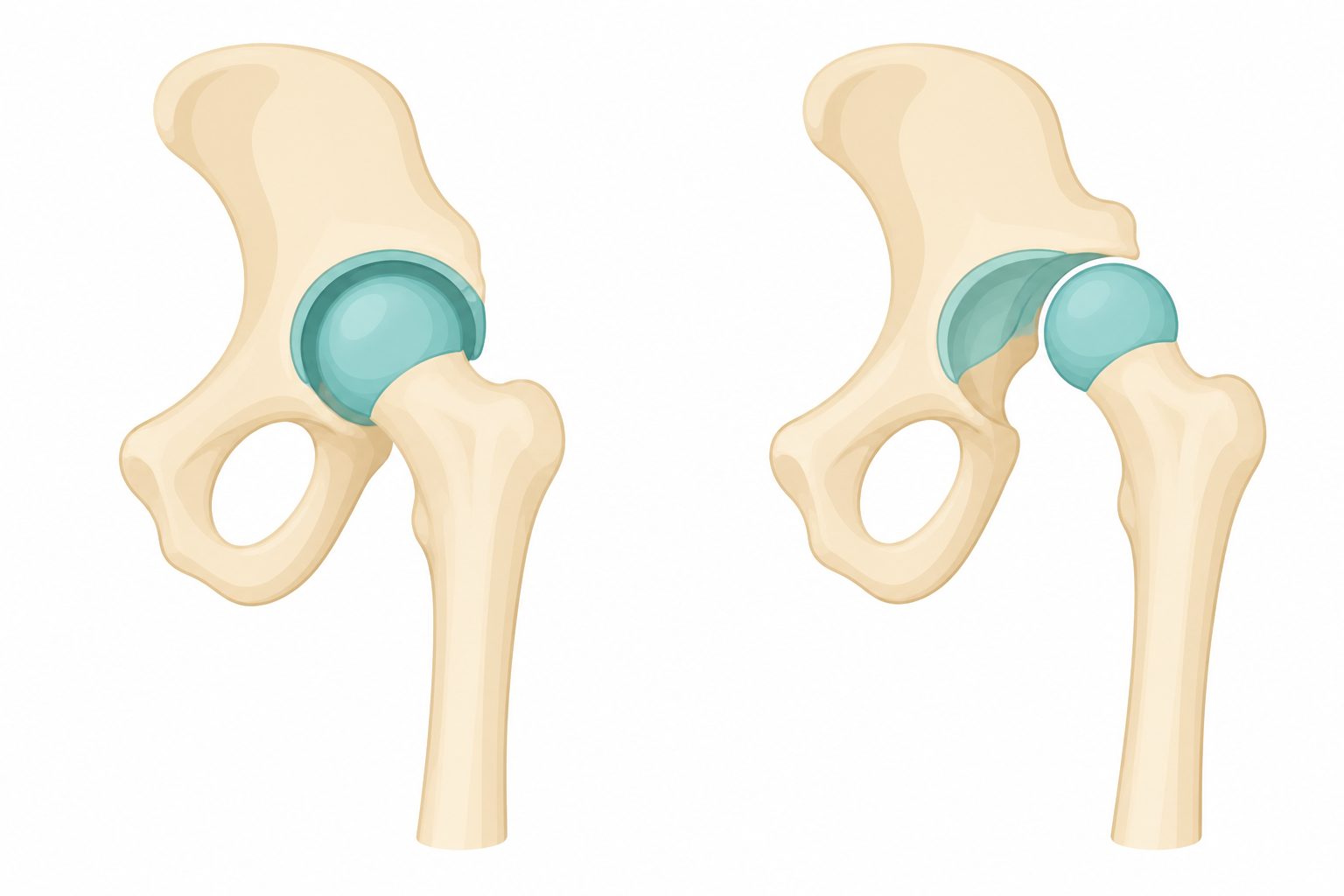
The hip is a ball-and-socket joint. The ball is the rounded top of the thigh bone (the femoral head); the socket is a cup in the pelvis (the acetabulum). In a newborn, much of this joint is soft cartilage rather than hard bone. The ball and socket shape each other as the baby grows: a ball held snugly in the socket encourages a deep, rounded cup to form.
When the ball is not held securely, the socket can stay shallow and the joint can become loose. Doctors describe a range of problems, from mild to severe. Understanding which one your baby has helps you follow the conversation at appointments:
- Dysplastic hip: the socket is shallower than expected, but the ball is in place. Often found only on ultrasound.
- Unstable or dislocatable hip: the ball is in the socket at rest but can be gently pushed out during an examination (a positive Barlow test).
- Subluxated hip: the ball is partly out of the socket, sitting off-centre.
- Dislocated but reducible hip: the ball sits outside the socket but can be guided back in (a positive Ortolani test).
- Dislocated, irreducible hip: the ball is out and cannot be guided back in by gentle examination. This usually needs a different treatment plan.
How common are hip dislocations in newborns?
Hip looseness at birth is fairly common, and many of these hips settle within the first few weeks as the hormones from pregnancy wear off and the ligaments tighten. Hips that need treatment are less common: the NHS estimates that around 1 to 2 in every 1,000 babies have DDH that requires treatment. Rates vary between countries and depend on how hips are screened.
The left hip is affected more often than the right, and both hips can be affected. Girls are affected more often than boys, which our guide on hip dysplasia in girls explains in more detail.
Why do newborn hips dislocate? Causes and risk factors
There is usually no single cause, and nothing a parent did during pregnancy causes DDH. A mix of genes, hormones and the baby's position in the womb affects how loose the hip ligaments are and how much room the hips had to develop. A true injury that dislocates a healthy hip during delivery is rare; most newborn hip dislocations are DDH.
Doctors pay closer attention to babies with these risk factors. Having one does not mean your baby has a problem, and many babies with DDH have no risk factors at all:
- Breech position in the later part of pregnancy, even if the baby turned or was born by caesarean section.
- A parent, brother or sister who had hip dysplasia or hip problems treated in childhood.
- Being a girl, partly because of greater sensitivity to pregnancy hormones that loosen ligaments.
- Being a first baby, when the womb is tighter.
- Low amniotic fluid (oligohydramnios) or a large baby, which leave less space for movement.
- Other 'packaging' conditions such as certain foot shape differences or a tight neck muscle (torticollis); clinics differ on which of these trigger a scan.
- Tight swaddling with the legs held straight and pressed together after birth.
Signs of a dislocated hip in a newborn that parents may notice
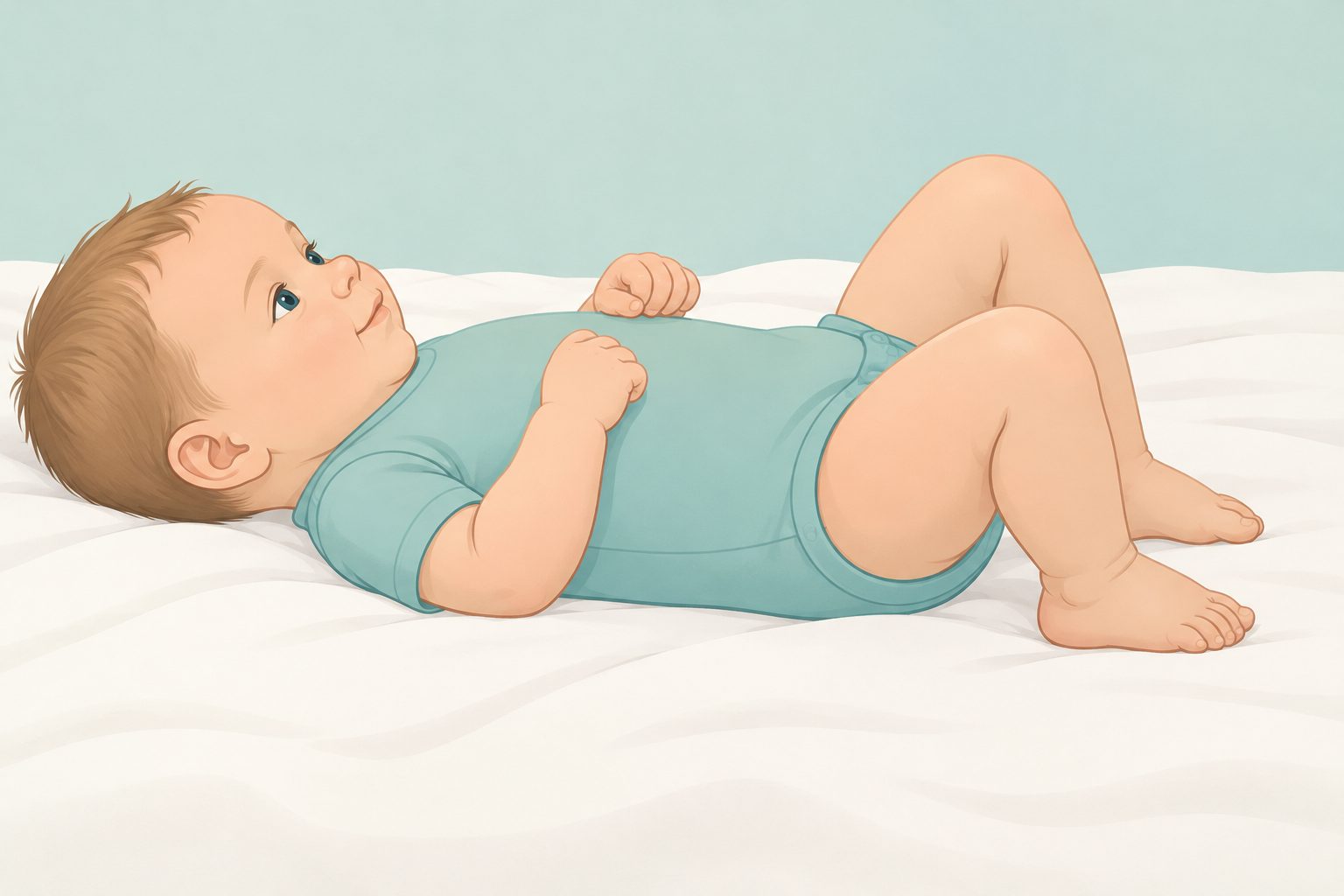
Many newborns with a dislocated hip have no obvious signs, which is why routine examinations matter. When signs are present, they can be subtle. Look for patterns rather than single features, and bring any concern to your baby's doctor or health visitor rather than repeatedly testing the hips yourself:
- One leg looks shorter, or one knee sits lower when your baby lies with knees bent and feet together.
- One leg does not spread out to the side as far as the other during nappy changes.
- Uneven skin creases on the thighs or buttocks. This is common in healthy babies too, so it matters most alongside other signs.
- A leg that turns outward more than the other, or moves noticeably less.
- In older babies and toddlers who were not diagnosed early: a limp, walking on the toes of one foot, a waddling walk, or a curve in the lower back.
Clicks versus clunks: which sounds matter?
Parents often notice clicking sounds from a baby's hips or knees. A soft, high-pitched click is common and usually comes from ligaments or tendons moving. On its own, it is not a reliable sign of DDH.
What examiners feel for is different: a 'clunk', which is the sensation of the ball moving into or out of the socket. It is felt by a trained examiner using specific movements more than it is heard. If you hear repeated clicks or feel something unusual, mention it at your next check-up, but avoid testing the hips yourself, because repeated forceful testing is unhelpful. Our guide to hip clicks and clunks covers this in detail.
How doctors check newborn hips: the Ortolani and Barlow tests
Many countries examine every baby's hips shortly after birth and again at around 6 to 8 weeks. With the baby relaxed on their back, the examiner bends the hips and knees and gently moves each leg. These checks take less than a minute and should not hurt.
The Barlow test checks whether a hip that is in the socket can be gently pushed out. The examiner brings the thigh slightly inward and applies light backward pressure. If the ball slips to the edge of or out of the socket, the hip is described as dislocatable or Barlow positive.
The Ortolani test checks whether a hip that is already out can be guided back in. The examiner gently moves the thigh outward while lifting slightly. A clunk as the ball returns to the socket means the hip was dislocated but reducible, or Ortolani positive.
Both tests are most useful in the first weeks. As babies get older and their muscles tighten, a dislocated hip may no longer move in and out. Doctors then rely more on limited spreading of the leg (reduced abduction), a difference in thigh length, and imaging. A normal newborn examination is reassuring, but it does not rule out every hip problem, so keep later checks too.
Hip ultrasound and X-ray: how the diagnosis is confirmed

In young babies, the ball of the hip is still mostly cartilage, which does not show clearly on X-ray. Ultrasound is therefore the main test in the first months. Your baby lies on their side while a probe with a little gel is placed on the outside of the hip. It is painless, and many babies sleep through it.
The scan measures the shape of the socket (often reported as an alpha angle, using the Graf method) and how much of the ball is covered by the socket. A dynamic scan may also check whether the ball moves when the hip is gently stressed. Our guide on understanding your baby's hip ultrasound explains what the numbers mean.
Timing matters. A baby with an obviously dislocated hip on examination is usually referred quickly. For babies with risk factors but a normal examination, many guidelines advise scanning at around 4 to 6 weeks, because scans in the first days often show looseness that will resolve by itself. From around 4 to 6 months, as the ball starts turning to bone, an X-ray becomes more useful than ultrasound.
Will my baby grow out of a dislocated hip?
Some newborn hips that are loose or slightly shallow in the first days do improve by themselves. That is why your doctor may choose to examine again or repeat an ultrasound in a few weeks instead of starting treatment immediately. This careful watching is called active monitoring.
A hip that is truly dislocated, stays unstable, or still looks abnormal on a later scan is unlikely to correct itself, and treatment is usually recommended. The specialist decides based on the examination, the ultrasound measurements and your baby's age. Waiting without a plan is not recommended; ask what the next check is and when it happens.
Treatment for a dislocated hip in babies under 6 months: the Pavlik harness
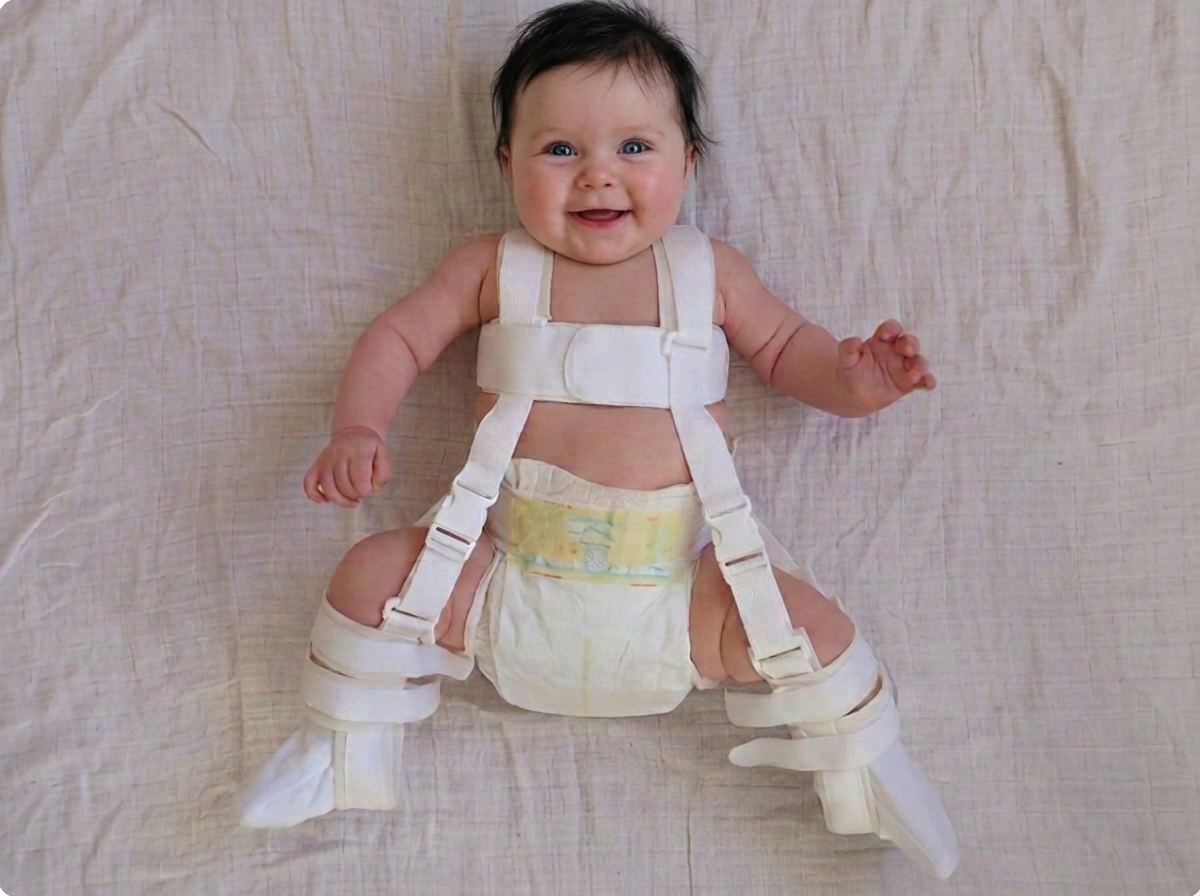
For most babies under about 6 months whose dislocated hip can be guided back into the socket, the first treatment is a Pavlik harness. It is a soft fabric brace with a chest strap, shoulder straps and stirrups around the lower legs. The straps hold the knees up towards the tummy with the hips bent and allowed to fall gently outward. In this position, the ball tends to settle into the socket and stay there, which encourages the socket to deepen.
The harness does not force the legs apart. Babies can still kick and move within the safe range, and that movement helps the ball find its place. A specialist fits the harness, sets the straps for your baby's hips and teaches you how to care for your baby while it is on.
With a dislocated hip, the team will want to confirm early, usually within the first 2 to 3 weeks, that the ball has moved back into the socket. This is checked by examination and ultrasound. If the hip is going back in, treatment continues, often full-time at first, for several weeks to a few months in total. If the hip has not gone back in, the team usually stops the harness and moves to another approach, because continuing a harness that is not working can affect the socket.
Studies report that many young babies with reducible dislocations are treated successfully with a Pavlik harness, although success is lower for complete dislocations than for milder dysplasia, and lower again for hips that cannot be guided back in at the start. Your specialist can explain what to expect for your baby's specific findings.
If the harness is not enough: other treatments
A minority of babies need a different treatment, either because the hip did not respond to the harness, because the hip could not be guided back in from the start, or because the problem was found later. Options include:
- Rigid abduction brace: a firmer brace that holds the hips spread apart, sometimes used after an unsuccessful harness or later in treatment.
- Closed reduction and spica cast: under general anaesthetic, the surgeon gently guides the ball back into the socket without an incision, often checks it with a special X-ray dye study (arthrogram), and sometimes releases a tight groin tendon. A body cast called a hip spica holds the position for several months.
- Open reduction: an operation through a small incision to clear anything blocking the ball and place it in the socket, used when closed reduction is not possible or in older babies.
- Bone surgery (osteotomy): in older toddlers and children diagnosed late, the socket or thigh bone may need reshaping.
Possible risks and side effects of treatment
Pavlik harness treatment is generally safe when fitted and monitored by an experienced team. Parents should still know what to watch for. Skin irritation in creases under the straps is the most common problem and is usually managed with careful hygiene. Rarely, too much bend at the hips can affect the femoral nerve, which shows up as a baby who stops kicking one leg; this usually recovers once the straps are adjusted by the clinician.
The most important rare complication of DDH treatment, with any method, is a disruption to the blood supply of the ball of the hip (avascular necrosis). This is the reason specialists avoid forcing the hips wide apart, and the reason follow-up X-rays continue after treatment. Our guide on Pavlik harness side effects explains these risks in more depth.
Caring for your baby during treatment
Day-to-day life continues during harness treatment. Babies can feed, sleep, cuddle and go out. The detail depends on your clinic's instructions, especially whether the harness may come off at all. The practical points most families need are:
- Sleep: place your baby on their back on a firm, flat, clear sleep surface. Do not add pillows, positioners or rolled towels.
- Nappies: change nappies without lifting the baby by the ankles; slide a hand under the bottom instead.
- Clothing: choose loose clothes that go over the harness; keep a thin vest under the straps if your clinic allows it.
- Skin: check creases behind the knees, in the groin and under the chest strap daily for redness.
- Car seats and carriers: use seats and carriers that allow the hips to stay bent and spread, and ask your team before using them.
- Straps: do not change strap settings unless your team has taught and authorised you to.
Recovery and long-term outlook
When a dislocated hip is found and treated in the first months, most children develop a normal or near-normal hip and reach their motor milestones as expected. Some babies are slightly later to sit or crawl while in a brace and catch up afterwards.
Follow-up continues after the harness comes off. Your specialist will usually arrange X-rays as your child grows, sometimes until school age or beyond, because a socket can occasionally stay shallow and need further treatment. These checks are routine and help catch any remaining problem early.
Without treatment, a dislocated hip can lead to a limp, a difference in leg length, reduced movement and early arthritis in adulthood. This is why newborn screening and early treatment matter so much.
Hip-healthy habits at home
Healthy hips develop best when babies can bend their legs up and out freely. Whether or not your baby has DDH, use hip-healthy swaddling: wrap the arms and upper body if you like, but leave the legs loose enough to bend up and fall outwards. Avoid swaddling the legs straight and tight.
Choose baby carriers that support the thighs from knee to knee, with the hips bent and the knees slightly higher than the bottom (often called the M position). Our guide to hip-healthy swaddling and baby carriers shows what to look for.
When to call the doctor
Contact your baby's doctor if you notice uneven leg lengths, one leg that does not spread like the other, a limp or unusual walk in an older baby, or if your baby has risk factors and has not had a hip check or scan as planned.
If your baby is in a harness, call the treating team promptly about a leg that stops kicking or moves less, broken or persistently red skin, a harness that slips or no longer fits, or a baby who seems in pain. Seek urgent help for a cold, pale or blue foot, breathing difficulty or a baby who seems seriously unwell.
Questions to ask your baby's specialist
If you are waiting for a scan or appointment, write your questions down now and bring them with you. Do not start a brace, special swaddle or exercises without the treating team's instructions.
- Is my baby's hip dislocated, dislocatable or dysplastic, and on which side?
- What did the ultrasound show, and when will it be repeated?
- Do you recommend monitoring or treatment now, and why?
- If a harness is recommended, which brand and size, and who fits it?
- How many hours per day must it be worn, and can it ever come off?
- How will we know the hip has gone back into the socket, and when will that be checked?
- What happens if the harness does not work?
- How long will follow-up X-rays continue after treatment?
If your specialist recommends a Pavlik harness
Some clinics supply the harness; others ask parents to buy one. Before ordering, confirm the brand and size your specialist wants and how the fitting will be done. A shop cannot choose the size or set the straps for your baby.
Our Baby Hip Pavlik Harness™ comes in three infant sizes by chest circumference (Small 33–38 cm, Medium 38–44 cm, Large 44–50 cm). It costs $89 USD with free worldwide shipping, before any taxes or import charges. All sales are final and returns are not accepted, so please confirm the size with your clinician first. Use our size calculator to prepare for that conversation.
Frequently asked questions
Is a dislocated hip in a newborn painful?
Usually not. Most babies with a dislocated hip show no sign of pain, which is why routine hip checks are important even when a baby seems content.
What is the difference between hip dysplasia and a dislocated hip?
Hip dysplasia means the socket is shallower than expected. A dislocated hip means the ball sits outside the socket. Both are part of developmental dysplasia of the hip (DDH), which ranges from mild dysplasia to complete dislocation.
Can a dislocated hip in a newborn correct itself?
Some loose hips at birth stabilise within weeks, so doctors may re-examine or scan again before treating. A hip that stays dislocated or unstable is unlikely to correct itself and usually needs treatment.
How is a dislocated hip in a baby diagnosed?
A clinician examines the hips with the Ortolani and Barlow tests and checks leg length and spreading. An ultrasound confirms the diagnosis in babies under about 4 to 6 months; after that, X-rays are more useful.
How long does a baby wear a Pavlik harness for a dislocated hip?
It varies. Treatment often lasts from several weeks to a few months, usually full-time at first. The team checks within the first few weeks that the hip has gone back into the socket and adjusts the plan from there.
What happens if the Pavlik harness does not work?
The specialist may change to a rigid abduction brace or recommend a closed reduction under anaesthetic followed by a spica cast. Some babies need an operation called an open reduction.
Was a dislocated hip caused by something I did?
No. DDH is linked to genes, hormones and position in the womb. Tight leg-straight swaddling after birth can contribute, which is why hip-healthy swaddling is recommended, but parents are not to blame.
Will my baby walk normally after treatment?
Most babies treated early for a dislocated hip walk normally. Some reach milestones slightly later while in a brace and catch up. Regular follow-up checks make sure the hip keeps developing well.
How much does your Pavlik harness cost?
The Baby Hip Pavlik Harness™ is $89 USD with free worldwide shipping, before any applicable taxes or import charges. All sales are final; returns are not accepted.
Practical guides for your next step
Sources
- NHS — Developmental dysplasia of the hip
- OrthoInfo (AAOS) — Developmental dislocation (dysplasia) of the hip (DDH)
- International Hip Dysplasia Institute — Infant diagnosis
- Cleveland Clinic — Hip dysplasia
- Better Health Channel (Victoria) — Developmental dysplasia of the hip (DDH)
- American Academy of Orthopaedic Surgeons — Infant DDH clinical practice guideline
- Johns Hopkins Medicine — Pavlik harness treatment for children